Getting back to the research trip in October and November…
On Friday, October 30, Alice and I set out from Shropshire on the part of our journey that would follow Jane and Charles’s travels. Used to California highways, I had set what proved to be an unrealistically ambitious schedule for us.
I had been sad to learn that Jane Lane’s home, Bentley Hall, near Walsall in Staffordshire, was no longer standing, but the helpful staff at Moseley Hall gave us directions to find a cairn that had been erected on the site, saying that it was opposite the Lane Arms pub.
When we got to the Bentley area, we were confused. The Lane Arms was unfortunately burned down, and though we looked for 20 or 30 minutes, we didn’t see a cairn, either across Wolverhampton Road or Queen Elizabeth Road. On the site where I thought the hall must have stood, just off the northeast corner of Wolverhampton Road and Queen Elizabeth Road, there was nothing but what looked like the beginning of a construction project. How depressing! Not only was Bentley Hall gone, but its remnants were going to be buried forever! It was also dispiriting to find that Bentley is now a somewhat grim corner of the outskirts of Birmingham.
Having come all the way from California to research the book, I didn’t want to give up without another try. We’d had good luck so far on the trip just asking local people to help us find places we were looking for, so we popped into the local Costcutter to ask if anyone knew anything about Bentley Hall. We were in luck! A lady told us that Pauline Gibson, who lived just down the street, knew everything about the area. So we intrepidly found the house and knocked on the door. No one home! A helpful neighbor promised to give Pauline my note, but didn’t know anything about Bentley Hall.
Now what to do? We didn’t know when Pauline might be back and we had a lot of ground to cover that day. Maybe the cairn had been pulled down or we were looking in the wrong place. But on a whim, I decided to make use of modern technology – my iPhone! I Googled “Bentley Hall Staffordshire,” and was amazed and pleased to find an article by Michael Shaw and Danny McAree about the rediscovery of the ruins of Bentley Hall only a few months earlier! We were in the right place, or pretty close. It was very exciting to realize that we were standing on or near the spot where Bentley Hall had been, where Charles II had arrived in the dead of night and set off with Jane Lane on their great adventure.
Pauline was kind enough to call me later in the day. Unfortunately by that point we were near Packington Hall in Warwickshire, where Jane lived later, when she married Sir Clement Fisher, and couldn’t go back to Bentley. But at least we knew we had been close.
Since then, I’ve found further information about the site on line. Apparently the cairn was there, we just didn’t go quite north enough of Wolverhampton Road.
I’ve also been delighted to discover historical maps online that give a pretty good idea of what the Bentley area must have looked like in 1651. It’s very interesting to see that the present day Wolverhampton Road still follows exactly the path it did then, and that the present Bentley Mill Lane is in fact where a little road ran from Bentley Hall, which was about a quarter mile north of the Wolverhampton Road, down to the mill.
Shaw and McAree’s article can be found at:
http://www.localhistory.scit.wlv.ac.uk/articles/Hall/BentleyHall.htm
Another article about Bentley Hall, “The Secrets of the Stone,” can be found at:
http://www.walsall.gov.uk/index/leisure_and_culture/parks_and_countryside/bentley_cairn_the_secrets_of_the_stone.htm
The 1805 ordnance map of the Bentley area, and other historical maps, can be seen at:
http://www.visionofbritain.org.uk/place/place_page.jsp?p_id=7881
Tuesday, March 16, 2010


Saturday, January 30, 2010
Hot Off the Presses
Curiously, just after I ordered the full-sized reprint of the map from The Natural History of Staffordshire, I discovered that The Malthouse Press has just published a reduced size edition of the book - about 5 by 8 inches, paperback, and unfortunately without the map and without many of the plates, but still a good find, and at $28.50 much more affordable than even the folio-sized modern facsimile of the whole book. I found it (and several other rare books I needed for this project) at Powells (powells.com), definitely worth a look!
The Malthouse Press
Grange Cottage, Malthouse Lane
Barlaston, Staffordshire ST12 9AQ, UK
timcockin@yahoo.com
(01782)372067
"The Pocket Plot" ISBN 978-0-953918-7-6
The Malthouse Press
Grange Cottage, Malthouse Lane
Barlaston, Staffordshire ST12 9AQ, UK
timcockin@yahoo.com
(01782)372067
"The Pocket Plot" ISBN 978-0-953918-7-6
Sunday, January 17, 2010
Maps. Maps, and More Maps
The Royal Miracle is very much about journeys. First Charles fled when he was routed at the Battle of Worcester. The first plan discussed among those with him was to escape back to Scotland. It rapidly became apparent that was too risky and that he would better off taking refuge at Whiteladies in Shropshire while his friend Lord Wilmot found a way for him to get out of the country. The two of them secretly agreed to separately make their way back to London and meet at the sign of the Three Cranes in the Vintry, asking for each other under the name Mr. Ashburnham. They didn't tell their friends their plans - indeed, their friends begged not to know their plans, so they couldn't be forced into disclosing them. Then Charles and Wilmot decided that the better plan was to cross the Severn River and get into Wales, which was less heavily occupied than England, and leave the country at Swansea or another port. But that plan was discarded when they learned that the river was heavily guarded and would be impossible to cross without capture.
It was at this point that Jane came into the story. She had a pass for her and a manservant to travel from her home at Bentley, in Staffordshire, to Abbots Leigh, near Bristol, to visit a friend who was about to have a baby. Charles, disguised as that servant, made the trip with her, riding before her. When Bristol, too, was ruled out, they set out further south, to Trent in Dorset, with the intention of Charles finding a way out of the country at Weymouth in the south. Jane left Charles at Trent, believing him safe, but in fact it took another three weeks of running and hiding before he was able to set sail for France from Shoreham, near Brighthelmstone (now Brighton).
But Jane's travels weren't over when she got back to Bentley. She learned that her part in helping the King had been discovered, and that she, too, had to escape the country. So she and her brother walked to Yarmouth, on the east coast,and from there got passage to France.
But how did all this traveling take place? Charles's journey is pretty well documented, since many of the people involved later wrote accounts of the adventure, so that there are sometimes hour-by-hour, field-by-field descriptions of his route and what he did.
Jane's journey lies in shadows. And needless to say, the roads and means of travel in England have changed enormously since 1651. For instance, Birmingham, now the second largest city in England, is shown on period maps as a tiny hamlet, much smaller than Stafford, Lichfield, and even than Wolverhampton, Tamworth, and Newport.
Fortunately, I've discovered a wealth of information that is helping me figure out what the country looked like and how Jane probably traveled. One excellent source is a book I found at the shop of the British Library, Maps for Historians by Paul Hindle. This pointed me in the direction of finding maps that shed a lot of light on Jane's path.
Robert Plot's The Natural History of Staffordshire (1686) includes a huge foldout map of Staffordshire (where Jane lived) and plates showing Stafford, Lichfield, and many of the principal estates in the county, including Bentley and Blithfield, the home of her grandparents Walter Bagot and Elizabeth Cave Bagot. I was able to borrow it through Interlibrary Loan (a fantastic service - ask at your local library if you're looking for hard-to-find books). I really wanted the map, but the price of the one original or the book I found (about $1000!) was a little prohibitive. Even used modern facsimiles of the book are going for about $200 on Alibris and ABE. Fortunately, I was able to order a reprint of the map from Reg Blagden through ABE for only $25, and also found A Staffordshire Armorial for 1680 by Richard Williams, a modern booklet offering further information on the various families whose coats of arms are displayed on Plot's map, which I bought from Richard Sylvanus Williams Books through ABE.
Another fantastic source I learned about from Hingle's book is John Ogilby's Britannia, a Roadmap of England and Wales from 1675. I had found copies of a 1970 reprint for sale starting at about $80, but was ecstatic to discover on Biblio.com that The Captain's Bookshelf in North Carolina had a 1939 reprint for $45, which proved to be in fantastic condition - 100 full-color plates of maps from Jane's time! Ogilby's format is a little odd - the roads are depicted on scrolls, about 6 side by side across a page, which you read from bottom to top. But he actually measured the distances, and the scale of the map is one inch to the mile, so they offer fantastic detail. And he sets forth all the principal routes a traveler of the time might have needed. One of these is Cambridge to Coventry, the reverse of which was probably part of the way Jane traveled to get from Bentley to Yarmouth.
I still have to get caught up and describe the part of my trip to England that involved following in Jane and Charles's footsteps as they traveled from Bentley to Long Marston in Warwickshire, then to Abbots Leigh, then to Trent in Dorset, which was invaluable in being able to evoke their trip, but these maps fill in the gaps and are really helping me place myself in Jane's shoes on the road in England in the fall and winter of 1651.
Thursday, December 31, 2009
Running Into Charles at the Airport
I fell sadly behind on blogging in my last few days in England - the research adventures were piling up thick and fast, and it was hard to find the time to record what I was doing. I will get caught up, soon. But I will leave 2009 by reporting this little tidbit: when I flew home on November 11, who should be down the counter checking into the same flight but Rufus Sewell, who, among other things, did a really good job playing Charles II in the British miniseries "Charles II: The Power and the Passion." I made so bold as to accost him and tell him I was a big fan of his work, particularly his portrayal of Charles. I gave him my card, and he grinned and said, "The Darling Strumpet! I'll have to find that!" So if you're seeing this, Mr. Sewell, thanks! You made my day!
Sunday, November 8, 2009
Grey's Inn, Wilton's Music Hall, Bonfire Night
Grey's Inn Hall
On Friday my friend Clare, who is a barrister, took me to lunch at Grey's Inn Hall . Grey's Inn, Lincoln's Inn, The Middle Temple, and the Inner Temple are the centuries-old law schools of England, where many barristers still have their chambers. Grey's Inn Hall is beautiful - hammer beam roof, dark and elaborately carved wood paneling, stained glass windows, etc. And rich with history. Besides its legal history, it was the site of early performances of some of Shakespeare's plays. No pictures were permitted, but you can see a photo of the interior at http://www.greysinn.info/ and learn more about Grey's Inn at http://en.wikipedia.org/wiki/Greys_Inn.
Wilton's Music Hall
Friday night I met some friends at Wilton's Music Hall (wiltons.org.uk and wiltonsthevenue.co.uk), an 1858 music hall that fell into disrepair and was long closed, used for non-performance purposes, and on the brink of destruction before it was recently saved and restored, and is once again presenting occasional performances. It's near Cable Street in Shadwell, an area of the East End of London near the river that was long associated with sailors and maritime life in general.
Music hall, if you don't know, was the English precursor to American vaudeville, with variety acts, singers and dancers - the working classes' entertainment that thrived during the Victorian era and even into the about the first quarter of the 20th century (http://en.wikipedia/wiki/music_hall)
Friday was a free film night, with screenings of some rather silly Rank Organization special short features from the 1960s on Piccadilly, London's clubs, London's markets, etc. Amazing to see the changes in many areas of London since then. And a big laugh at the chipper line "The London of the future will have no traffic jams!"
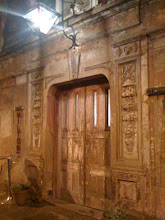
The Wilton's building is fantastic, with history oozing from every pore, as my friend Alice says. We sat in the balcony, which runs around three sides of the house, with a narrow rectangular stalls section below, and a proscenium stage with two levels. Beautiful twisting columns, ornate plaster work, all in a state of arrested decay and semi-restoration.
Part of the pleasure of the evening was just being in the place. Before the films we had some snacks and drinks in the Mahogany Bar, which according to the Wilton's web site has been a bar as far back as 1725. Afterwards, we sat upstairs in an area with brick walls and a fireplace that I think must have been some kind of public area, or maybe office or something, as it's on the wrong side of the building to be dressing rooms.
"Remember, remember the Fifth of November, Gunpower, Treason and Plot!"
Thursday night was Bonfire Night - the annual commemoration of Guy Fawkes's failed 1605 plot to blow up the King and Houses of Parliament (http://en.wikipedia.org/wiki/Guy_Fawkes_Night). Since then, the Fifth of November has been celebrated with bonfires, fireworks, and burning "Guys," or effigies of Guy Fawkes. Our commonly used term "guy" to refer to a man derives from this custom, incidentally. The guy came to mean not just the effigies that were burned, but any ragged-looking man, and then just any guy.
Since Bonfire Night fell on Thursday, most of the big public fireworks displays were on the weekend instead, so on Saturday night I walked with my friends Clare and Alex up to Blackheath to see the fireworks. Blackheath is a large open area just south of Greenwich, that has long been used as a gathering place and staging area before advancing on London. Wat Tyler's rebels gathered there in 1381 , Henry V arrived there on his way home from Agincourt in 1415, and in the 18th century, the old retired sailors housed in Greenwich played cricket on the heath. One of my favorite tales is of a game of the one-legs against the one-arms, with a naval carpenter standing by to make repairs and replacements. For more, see http://en.wikipedia.org/wiki/Blackheath,_England.
The fireworks were great - a 20 minute display to music, and a big crowd was gathered. It really is pretty much exactly like the Fourth of July celebrations in the U.S. I didn't take into account exactly how the crowds would impact our getting around, and afterward we made our way, slowy, slowly to Donna's house in Lewisham. The streets and busses were packed, so we walked from Blackheath to Lewisham Station (quite a ways) and then got a bus to Donna's, not arriving until 10 p.m.
We missed the burning of the guy but got there in time for Tim setting off some fireworks that came perilously close to the house and throwing a couple of old Christmas trees on the embers of the bonfire and creating a raging inferno, as well as having mulled wine, hot soup, sausages, and pies.
Yesterday and today the Docklands Light Rail and several lines of the underground were closed for repairs (a regular and annoying feature of London life these days, as the city spruces itself up for the 2012 Olympics). This complicated transportation a lot, so over the weekend I mostly stayed around Greenwich and did research work and following up various inquiries on line, but this afternoon I went to see my friend Bucky in town, taking the Thames Clipper, referred to as the river bus, a much more enjoyable means of transportation than the underground, anyway.
Thursday, November 5, 2009
The National Portrait Gallery and the Old Vic
Today I met my friend Laura for a lecture at the National Portrait Gallery (npg.org.uk) and then spent a while in the gallery looking at portraits of people relevant to Jane Lane's story as well as Nell Gwynn's. They have a nice service on which you can search for portraits and then either print free black and white copies or pay for really good quality color prints, so I got color prints of Jane's post-Restoration portrait and the Isaac Fuller portrait of her and Charles on horseback.
I tried to arrange to see the pictures in person while I'm here and the lady who helped me did her best to make it happen, but unfortunately it wasn't possible in the time that I have left here - a casualty of this trip being so hastily arranged! Next time...
This evening I went to the Old Vic (oldvictheatre.com) and saw the really fantastic production of "Inherit the Wind" directed by Trevor Nunn, with Kevin Spacey as Henry Drummond and David Traughton as Matthew Harrison Brady.
The Old Vic is one of London's oldest and most distinguished and history-laden theatres. It was built in the early 19th century, and has been the scene of performances by many, many theatrical luminaries including Edmund Kean, Edith Evans, Laurence Olivier, Ralph Richardson, John Gielgud, Flora Robson, Charles Laughton, Alec Guinness, Richard Burton, Peter O'Toole, Anthony Hopkins, Albert Finney, Joan Plowright, Maggie Smith, Glenda Jackson, and Judi Dench. When Olivier was appointed first director of the National Theatre, the Old Vic served as its first home from 1962-1967. Olivier gave his last stage performance at the Old Vic in 1973, and if his ghost walks anywhere, it must surely be there.
The theatre has been saved when on the brink of destruction many times. In 1998 it was for sale and in danger of becoming a pub or lap dancing club. Kevin Spacey is the theatre's most recent savior. He became Artistic Director in 2003 and the Old Vic once more became a producing house. I've seen three of the six shows in which he has starred here since then("National Anthems" and "Richard II" as well as the current production) and also the outrageous Christmas pantomime with Sir Ian McKellan as Mother Goose and last year's wonderful "Pygmalion," and Mr. Spacey has really done a phenomenal job of producing really good theatre and packing the house. Not easy!
Wednesday, November 4, 2009
Meanwhile, back in London...
I WILL get caught up on the "Thelma and Louise Tour England" portion of my trip, but meanwhile, I'll chronicle my last couple of days. Yesterday I went to the British Library and secured a reader card, which allows me into the various specialized reading rooms (there is no general library). They don't give them out just for the asking, apparently - you have to convince them you have a reason to be there! So I was glad to get that settled and begin my digging.
I'd done a little looking through the catalogue in advance and found a few things I knew I wanted to see, but also had general areas of inquiry for which I didn't quite know how to begin or what I'd find. Among these - I had learned that the library had Charles II's copy of the Second Folio of Shakespeare's plays. Access to it is restricted, so I filled out the paperwork to ask to see it. Meanwhile, what I could get access to was an archival facsimile of Charles I's copy of the Second Folio, which is held in the Windsor Castle Library. I got that today -- he made a few notes but nothing astonishing. Still, interesting to see the version of the plays that the young Charles II would have seen -- and which Jane Lane's father might well have owned.
Had a look at a 1912 book called "The Royal Miracle" (the contemporary description of Charles's complete adventure) which included various contemporary accounts and other useful miscellany, including an almanac of the phases of the moon in September and October, 1651!
Also found the book that the Salt Library had recommended to me - Lane of Bently Hall by Henry Murray Lane, published in 1898. Quite interesting information about the history of Jane's family, who had been in Staffordshire for more than 700 years as of 1898, and had apparently come to England with William the Conqueror. They were quite well-connected -- had had a coat of arms since Lancastrian times, and I was suprised to learn that one of Jane's maternal great-great-grandmothers was the aunt of the Countess of Oxford (her brother's daughter married the Earl, that is) and one of Jane's paternal great-grandmothers was the sister of William, Lord Burleigh!
Another area of my research was to find out where and when Jane might have had the opportunity to see a Shakespeare play before the theatres were closed, so I followed some trails involving the King's Men, The Prince's Men, their repertories and provincial touring, closures of the London theatres due to plague, and itineraries of various royal progresses, working my way through G.E. Bentley's The Jacobite and Caroline Stage (in five volumes), Edmund Chambers's The Elizabethan Stage (two volumes), and the Calendar of State Papers for various years in the reign of Charles I.
Reading through the minutiae of petitions, grievances, naval promotions, political skirmishes, complaints by the Bristol soapmakers that the London soapmakers are stepping on their territory, etc., certainly brings home what a lot of people there have been doing quite a lot of things that were important to them since the world began, even if we've never heard of them. It's like someone ploughing through the White House emails of 2009 a few hundred years from now.
Meanwhile, today, Alice gave me a huge amount of help in my research by making some calls and emails looking into the issue of riding pillion -- the sidesaddle behind a rider astride fashion in which Jane travelled with Charles. During our jaunt she referred to herself as the Watson to my Holmes, and like Holmes, I've been lucky to have an intelligent and dogged sidekick for the past week or so!
Last night I had an enjoyable break from all hard work! - met up with some of my old gang -- Alice, Alison, Tim, Clare, Alex -- for the pub quiz at the Lord Nelson Pub on the Isle of Dogs, across the street from where I lived while here in 2005-2006. Actually, this circle of friends (including others who were absent last night) developed around our participation in the Nelson's pub quiz, in the golden days of yore, when Spencer and John ran the quiz, then weekly, and we won quite frequently, using our prize (the 1 pound collected from each player) to pay for our food and drinks the next week. Unfortunately, last night Donna, our ace in the hole of obscure knowledge, was at her Gunmaker's Dinner, and without her we were not at our best.
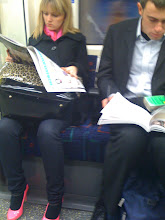
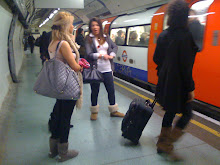
And finally - the burning question I'm sure you all want to know - what are the girls in London wearing now? Black opaque tights, mostly. With long skirts, short skirts, shorts (!), boots of many lengths and heel heights. Add a jacket, a big scarf, a really big bag, and a cell phone, and you're there!
Subscribe to:
Posts (Atom)