Hi, dear readers,
Please join me and dozens of your favorite authors at the 2011 Halloween Mash at Writerspace tonight from 8pm ET to 11pm ET. We’re giving away 100s of fantastic prizes -- Kindles, autographed books, gift cards and more. The more who enter, the more Kindles will be awarded! You don't have to be present to win, but you must be registered. I'm giving away a copy of The September Queen, which will be released on Tuesday! To register and for details visit http://www.writerspace.com/halloween/
Sunday, October 30, 2011


Tuesday, October 25, 2011
September Queen blog tour dates
Hello, friends,
I have quite an exciting blog tour lined up in connection with the November 1 release of The September Queen. I'm thrilled to be working again with so many of the wonderful bloggers who promoted The Darling Strumpet. Here's what's up so far, but check back because there are still dates to be added:
October 27 - Historical Fiction Connection
http://www.hf-connection.com/2011/10/giveaway-amazing-untold-real-life.html
guest post "The Amazing Untold Real-Life Adventure of Jane Lane" and giveaway
October 28 - Pittsburgh Historical Fiction Examiner
http://www.examiner.com/historical-fiction-in-pittsburgh/book-review-the-september-queen-by-gillian-bagwell
great review!
October 31 – Peeking Between the Pages
guest post "Jane Lane and the Royal Miracle" and giveaway
November 1 - Seductive Musings
http://seductivemusings.blogspot.com/2011/11/giveaway-september-queen-by-gillian.html?zx=1e8e86a0ff75085a
giveaway and excerpt
November 1 - Passages to the Past
http://www.passagestothepast.com/2011/11/guest-post-by-gillian-bagwell-author-of.html
guest post "Riding Pillion" and great review!
November 2 - Savvy Verse and Wit
http://savvyverseandwit.com/2011/11/guest-post-the-next-best-thing-to-being-there-by-gillian-bagwell.html
guest post "The Next Best Thing to Being There" and giveaway
November 2 - Scandalous Women
http://scandalouswoman.blogspot.com/2011/11/guest-post-author-gillian-bagwell-on.html
guest post "The Girl Who Saved the English Monarchy" and giveaway
November 2 - My Book Addiction
http://mybookaddictionandmore.com/2011/11/03/a-visit-and-giveaway-with-gillian-bagwellauthor-of-the-september-queen/
Guest post "Jane Lane and the Royal Miracle" and giveaway
November 4 - Lori’s Reading Corner
http://www.lorisreadingcorner.com/2011/11/guest-post-giveaway-with-gillian-bagwell.html
guest post "The Royal Oak" and giveaway
November 5 - In the Hammock
http://inthehammockblog.blogspot.com/2011/11/giveaway-september-queen.html
giveaway
November 7 - Wonders and Marvels
http://www.wondersandmarvels.com/2011/11/the-royal-miracle.html
guest post "The Royal Miracle"
November 9 - Season for Romance
http://theseasonforromance.com/wordpress/2011/11/the-most-romantic-ride-of-all-time/
guest post "The Most Romantic Ride of All Time?" and giveaway
November 9 - Historical Fiction Examiner
http://www.examiner.com/historical-fiction-in-pittsburgh/10-questions-with-historical-fiction-author-gillian-bagwell
Q&A
November 10 - Unusual Historicalshttp://unusualhistoricals.blogspot.com/2011/11/excerpt-thursday-september-queen-by.html
excerpt
November 10 - Broken Teepee
http://www.brokenteepee.com/2011/11/book-review-september-queen-by-gillian.html
review
November 11 - Historical Tapestry
http://historicaltapestry.blogspot.com/2011/11/royal-oak-by-gillian-bagwell.html
guest post "The Royal Oak"
November 11 - Historically Obsessed
http://historicallyobsessed.blogspot.com/2011/11/guest-post-gillian-bagwell-priest-holes.html
guest post - "Priest Holes"
November 13 - Unusual Historicals
http://networkedblogs.com/pUWcm
http://unusualhistoricals.blogspot.com
http://crazy-for-books.com/2011/11/guest-post-giveaway-with-author-gillian-bagwell.html
guest post "The Royal Miracle" and giveaway
November 15 - The Muse in the Fog
http://muse-in-the-fog.blogspot.com/2011/11/guest-post-gillian-bagwell-author-of.html
guest post - "Portait Miniatures"
great review!
November 22 - Broken Teepee
Guest post - Seventeenth Century Memorabilia
http://www.brokenteepee.com/2011/11/guest-post-and-rafflecopter-giveaway.html
November 28 - Penguin – The Author’s Desk blog
http://community.penguin.com/_When-You-Cant-Get-There-from-Here-by-Gillian-Bagwell/blog/5527330/150186.html
"When You Can't Get There from Here"
November 30 - Penguin - The Author's Desk blog
http://community.penguin.com/_The-Royal-Oak-by-Gillian-Bagwell/blog/5534872/150186.html?SMC-PTWT2011
"The Royal Oak"
December 2 Penguin - The Author's Desk blog - The Royal Miracle
http://community.penguin.com/_The-Royal-Miracle-by-Gillian-Bagwell/blog/5541825/150186.html
I have quite an exciting blog tour lined up in connection with the November 1 release of The September Queen. I'm thrilled to be working again with so many of the wonderful bloggers who promoted The Darling Strumpet. Here's what's up so far, but check back because there are still dates to be added:
October 27 - Historical Fiction Connection
http://www.hf-connection.com/2011/10/giveaway-amazing-untold-real-life.html
guest post "The Amazing Untold Real-Life Adventure of Jane Lane" and giveaway
October 28 - Pittsburgh Historical Fiction Examiner
http://www.examiner.com/historical-fiction-in-pittsburgh/book-review-the-september-queen-by-gillian-bagwell
great review!
October 31 – Peeking Between the Pages
guest post "Jane Lane and the Royal Miracle" and giveaway
November 1 - Seductive Musings
http://seductivemusings.blogspot.com/2011/11/giveaway-september-queen-by-gillian.html?zx=1e8e86a0ff75085a
giveaway and excerpt
November 1 - Passages to the Past
http://www.passagestothepast.com/2011/11/guest-post-by-gillian-bagwell-author-of.html
guest post "Riding Pillion" and great review!
November 2 - Savvy Verse and Wit
http://savvyverseandwit.com/2011/11/guest-post-the-next-best-thing-to-being-there-by-gillian-bagwell.html
guest post "The Next Best Thing to Being There" and giveaway
November 2 - Scandalous Women
http://scandalouswoman.blogspot.com/2011/11/guest-post-author-gillian-bagwell-on.html
guest post "The Girl Who Saved the English Monarchy" and giveaway
November 2 - My Book Addiction
http://mybookaddictionandmore.com/2011/11/03/a-visit-and-giveaway-with-gillian-bagwellauthor-of-the-september-queen/
Guest post "Jane Lane and the Royal Miracle" and giveaway
November 4 - Lori’s Reading Corner
http://www.lorisreadingcorner.com/2011/11/guest-post-giveaway-with-gillian-bagwell.html
guest post "The Royal Oak" and giveaway
November 5 - In the Hammock
http://inthehammockblog.blogspot.com/2011/11/giveaway-september-queen.html
giveaway
November 7 - Wonders and Marvels
http://www.wondersandmarvels.com/2011/11/the-royal-miracle.html
guest post "The Royal Miracle"
November 9 - Season for Romance
http://theseasonforromance.com/wordpress/2011/11/the-most-romantic-ride-of-all-time/
guest post "The Most Romantic Ride of All Time?" and giveaway
November 9 - Historical Fiction Examiner
http://www.examiner.com/historical-fiction-in-pittsburgh/10-questions-with-historical-fiction-author-gillian-bagwell
Q&A
November 10 - Unusual Historicals
excerpt
November 10 - Broken Teepee
http://www.brokenteepee.com/2011/11/book-review-september-queen-by-gillian.html
review
November 11 - Historical Tapestry
http://historicaltapestry.blogspot.com/2011/11/royal-oak-by-gillian-bagwell.html
guest post "The Royal Oak"
November 11 - Historically Obsessed
http://historicallyobsessed.blogspot.com/2011/11/guest-post-gillian-bagwell-priest-holes.html
guest post - "Priest Holes"
November 13 - Unusual Historicals
http://networkedblogs.com/pUWcm
http://unusualhistoricals.blogspot.com
Q&A and giveaway
November 14 - Crazy for Bookshttp://crazy-for-books.com/2011/11/guest-post-giveaway-with-author-gillian-bagwell.html
guest post "The Royal Miracle" and giveaway
November 15 - The Muse in the Fog
http://muse-in-the-fog.blogspot.com/2011/11/guest-post-gillian-bagwell-author-of.html
http://muse-in-the-fog.blogspot.com/2011/11/review-september-queen-by-gillian.html?spref=tw
November 18 – Historical Research
Guest post – The Next Best Thing to Being There – Recreating a Journey
http://historicalfictionresearch.blogspot.com/2011/11/next-best-thing-to-being-there.html
November 18 – Historical Research
Guest post – The Next Best Thing to Being There – Recreating a Journey
http://historicalfictionresearch.blogspot.com/2011/11/next-best-thing-to-being-there.html
November 22 - Broken Teepee
Guest post - Seventeenth Century Memorabilia
http://www.brokenteepee.com/2011/11/guest-post-and-rafflecopter-giveaway.html
November 28 - Penguin – The Author’s Desk blog
http://community.penguin.com/_When-You-Cant-Get-There-from-Here-by-Gillian-Bagwell/blog/5527330/150186.html
"When You Can't Get There from Here"
November 30 - Penguin - The Author's Desk blog
http://community.penguin.com/_The-Royal-Oak-by-Gillian-Bagwell/blog/5534872/150186.html?SMC-PTWT2011
"The Royal Oak"
December 2 Penguin - The Author's Desk blog - The Royal Miracle
http://community.penguin.com/_The-Royal-Miracle-by-Gillian-Bagwell/blog/5541825/150186.html
Tuesday, October 18, 2011
October 16, 1651 - France - at last
On October 15, Charles, with Lord Wilmot, finally boarded
Captain Tattersall’s boat and set sail for France. But, in keeping with the events of the past
six weeks, there was one final scare, as Charles described to Samuel Pepys in
1683.
“The next day we got to Roan to an Inn (one of the best in
the Towne) in the Fish-Market, where they made difficulty to receive us,
takeing us by our Cloathes to be some Theeves, or persons that had beene doeing
some very ill thing, untill Mr. Sandburne a Merchant (for whome I sent) came
and answered for us.
“We stayed at Roan one day to provide our selves better
Cloathes and give notice to the Queene my Mother (who was then at Paris) of my
being safely Landed. After which setting
out in a hired coach I was mett by my Mother with Coaches short of Paris, and
by her conducted thither, where I safely arrived.”
Charles arrived in Paris on October 20. He had been on the run, and in fear for his
life, since September 3. As of October
29, there were rumors in England that he had been lost at sea, as there had
been so many rumors since the Battle of Worcester about where he might be. But on October 30, newspapers in England
proclaimed the momentous news that he was at the French court, where he was welcomed
by his mother, Queen Henrietta Maria; his brother James, the Duke of York; and
his youngest sister Henrietta Anne, affectionately known as Minette.
Against all odds, and despite innumerable and overwhelming
difficulties, many times when he came close to being discovered, and the fact
that he was recognized by dozens of people who could have claimed a vast reward
for turning him, Charles had outrun and outwitted Cromwell and Parliament. The next eight and a half years were to be hard,
with constant penury and frequent despair.
But when Charles once again set foot on English soil, on May 25, 1660,
it was as king, returning in triumph to a nation joyful at his Restoration.
The six weeks that came to be known as the Royal Miracle because Charles so many times escaped what seemed to be certain disaster were an enormously formative period in his life. When he returned to the throne, he rewarded the many people who had helped them, and told the story of his adventures for the rest of his life.

“The next morning a little before day we saw the Coast. But the tyde fayling us and the Winde comeing
about to the South-West, we were forced to come to an Anchor within 2 Myles of
the share, till the tide of Flood was done.
 |
| Oostend fisheman/privateers |
“We found our selves just before an Harbour in France called
Feckham [Fécamp], and just as the tyde of Ebb was made, espied a
Vessell to Leeward of us, which by her nimble working, I suspected to be an
Ostend-Privateer. Upon which I went to my
Lord Willmott, and telling him my oppinion of that ship proposed to him our
goeing a Shoare in the Little Cock-Boate, for feare they should prove soe, as
not knowing but finding us goeing into a
Port of France (there being then a Warr between France and Spaine) they might
plunder us and possibly carry us away and sett us a-shoare in England; the
Maister himselfe had the same opinion of her being an Ostender, and came to me
to tell me soe. Which though I made it
my business to diswade him from, for feare it should tempt him to sett sayle
back againe with us for the Coast of England, yet soe sensible I was of it that
I and my Lord Willmott went both on shoare in the Cock-Boate, and goeing up
into the Towne of Feckham stayed there all the Day to provide horses for Roan
[Rouen]. But the Vessell which had soe affrighted us proved afterwards only a
French sloop.
 |
| Rouen in 1680 |
One particular more there is observable in Relacion to this
our Passage into France, that the Vessell that brought me over had noe sooner
Landed me, and I given her Maister a Pass, for feare of meeting with any of our
Jerzey-Friggates, but the Winde turned soe happily for her as to carry her
directly for Poole, without its being knowne that she had ever beene upon the
Coast of France.
 |
| 17th century drawing of St. Hillary's Gate into Rouen |
 |
| Rouen, with buildings that would have been there when Charles was |
|
| Charles's mother, Queen Henrietta Maria |
The six weeks that came to be known as the Royal Miracle because Charles so many times escaped what seemed to be certain disaster were an enormously formative period in his life. When he returned to the throne, he rewarded the many people who had helped them, and told the story of his adventures for the rest of his life.
 |
| Charles II, with his brothers riding into London in May 1660 |
If you're just joining us...
Welcome, readers from Good Reads and anyone else who's just found me! If you're interested in reading about Charles's six-week odyssey trying to escape after the Battle of Worcester, go back to the post about September 3, 1651, and follow on from there!
Also, I plan to be adding more photos and other images to some of the earlier posts, so anyone who's been reading might want to check back in a week or two.
Thanks for reading!
Also, I plan to be adding more photos and other images to some of the earlier posts, so anyone who's been reading might want to check back in a week or two.
Thanks for reading!
Monday, October 17, 2011
October 15, 1651 - Farewell to England
Colonel Gounter had persuaded Charles and Lord Wilmot to lie
down and get some rest late on the night of October 14, and in the wee hours he
“called them up, shewing them how the tyme went by my watch. Horses beeing led
by the back way toward the beach, we came to the boate and found all readie.”
Charles described this last leg of his journey through England, from Brighton to Shoreham, to Samuel Pepys in 1683. “About 4 a Clock in the morning, my selfe and the Company before named went toward Shoram, takeing the Maister of the Shipp with us on horseback, behinde one of our Company, and came to the Vessells side, which was not above 60 Tunn.”
Gounter, who it seemed had finally achieved the near
impossible in finding passage for the king away from England, recalled his
final moments with Charles.
“Soe I tooke my leave, craving his Majesties pardon if anything had happened through error, not want of will or loyaltie. How willingly I would have waited further but for my family (being many), which would want mee; and I hope his Majestie would not, not doubting but in a very little tyme hee should bee where he would.”
Gounter, like the many other people who had sheltered and
helped Charles over the six weeks since the Battle of Worcester, had risked his
life for the king, as he would have been arrested and executed for treason if
what he had done became known to Parliament.
“My only request to his Majestie,” Gounter recalled, “was that he would conceale his instruments, wherein their preservation was soe much concerned. His Majestie promist noebody should knowe.”
Charles was no doubt ready to drop with exhaustion and stress, and probably wanted desperately to be aboard in case anything else should go wrong. “It being low Water, and the Vessell lying dry, I and my Lord Willmott got up with a ladder into her and went and lay downe in the little Cabbin, til the tide came to fetch us off.
Colonel Gounter stood watching from the shore. “At 8 of the clock I saw them on sayle, and it was the afternoon before they were out of sight. The wind (O providence!) held very good till next morning to ten of the clock.”
Charles didn’t know it yet, but his friend and faithful ally the Earl of Derby, who had accompanied him on his desperate flight from Worcester to Whiteladies on the night after the battle, was executed for treason on the same day the king was finally making his way toward France.
Charles described this last leg of his journey through England, from Brighton to Shoreham, to Samuel Pepys in 1683. “About 4 a Clock in the morning, my selfe and the Company before named went toward Shoram, takeing the Maister of the Shipp with us on horseback, behinde one of our Company, and came to the Vessells side, which was not above 60 Tunn.”
 |
| Map of Charles's route from Allan Fea's 1897 The Flight of the King |
“Soe I tooke my leave, craving his Majesties pardon if anything had happened through error, not want of will or loyaltie. How willingly I would have waited further but for my family (being many), which would want mee; and I hope his Majestie would not, not doubting but in a very little tyme hee should bee where he would.”
 |
| "A proclamation for the Discovery and Apprehension of Charles Stuart, and other Traytors his Adherents and Abettors" |
“My only request to his Majestie,” Gounter recalled, “was that he would conceale his instruments, wherein their preservation was soe much concerned. His Majestie promist noebody should knowe.”
Charles was no doubt ready to drop with exhaustion and stress, and probably wanted desperately to be aboard in case anything else should go wrong. “It being low Water, and the Vessell lying dry, I and my Lord Willmott got up with a ladder into her and went and lay downe in the little Cabbin, til the tide came to fetch us off.
“But I was no sooner gott into the Shipp and Layn downe upon
the Bedd, but the Maister came in to me, fell downe upon his Knees and kist my
hand, telling me that he knew me very well, and that he would venture Life and
all that he had in the World to sett me downe safe in France.
“Soe about 7 a Clock in the Morning it being High-Water, we
went out of the Port. But the Maister
being bound for Poole laden with Sea Coole, because he would not have it seene
from Shoram that he did not goe his intended Voyage; but stood all the day with
a very easy sayle toward the Isle of Wight (only my Lord Willmott and my selfe
of my Company on board), and as we were sayleing the Maister came to me and
desired me that I would perswade his Men to use their endeavours with me to get
him to sett us on shoare in France, the better to cover him from any suspicion
thereof.  |
| Shoreham by J.M.W. Turner |
“Upon which I went to the Men (which were 4 and a Boy) and
told them, truely, that we were 2 Merchants that had some misfortunes and were
a Little in Debt, that we had some money owing us at Roan in France and were
afraid of being arrested in England, that if they would perswade the Maister
(the Winde being very faire) to give us a Tripp over to Diepe or one of those
ports neere Roan, they would oblige us very much; and with that I gave them 20s
to drinck. Upon which they undertook to
second me if I would propose it to the Maister, soe I went to the Maister and
told him our condicion, and that if he would give us a Tripp over to France, we
would give him Consideracion for it.
Upon which, he counterfeited difficulty, saying that it would hinder his
Voyage. But his men, as they had
promised me, Joyned their perswacions to ours, and at last he yeilded to sett
us over.
“So about 5 a Clock in the afternoon (as we were in sight of
the Isle of Wight) we stood directly over for the Coast of France, the Winde
being then full North.”Colonel Gounter stood watching from the shore. “At 8 of the clock I saw them on sayle, and it was the afternoon before they were out of sight. The wind (O providence!) held very good till next morning to ten of the clock.”
Charles didn’t know it yet, but his friend and faithful ally the Earl of Derby, who had accompanied him on his desperate flight from Worcester to Whiteladies on the night after the battle, was executed for treason on the same day the king was finally making his way toward France.
 |
| A miniature of Charles by Samuel Cooper from The Flight of the King |
And there is little doubt that Charles would have suffered
the same fate if he had been captured.
To the end, luck was with him.
Gounter marveled, “I was not gone out of the towne twoe houres but
souldiers came thither to search for a tall black man, 6 foot and 2 inches
high.”
Sunday, October 16, 2011
October 14 - 1651 - so close and yet...
Charles went to bed on the night of October 13 at the home
of Colonel Gounter’s sister and her husband, Thomas Symonds. According to Gounter, “the King slept well
all night; and by breake of day, the Colonel putting twoe neats-tongues [ox
tongues] in his pocketts, which he thought they might neede by the way, they
sett out and began their journey.”
Charles’s heart must have sunk to see the troops – it was a
repeat of the situation he had encountered at Stratford-upon-Avon and Bridport,
though it was good they had left their post guarding the bridge.
“My Lord Wilmot was readie to turne back, when I stept in and said: ‘If wee doe, wee are undone. Lett us goe on boldly, and wee shall not be suspected.’ ‘He saith well,’ said the King. I went before, he followed, and soe pass through without any hinderance.
“It was then betweene three and fower of the clock in the afternoone. Wee went on, but had not gone farre but a new terror possessed us: the same soldiers riding after us, as fast as they could. Whereupon the King gave mee a hem. I slackt my pace till there were come up to mee, and by that tyme the soldiers were come, whoe rudely passed by us (beeing in a narrow lane), soe that we could hardly keepe out sadles for them; but passed by without any further hurt, being some 30 or 40 in number."
Another close call, and just when safety was almost in sight!
“When wee were come to Breeding, a little village where I
had provided a retreatement for the King (one Mr. Bagshall’s house), I was
earnest that his Majestie would stay there a whyle, till I had viewed the
coast. But my Lord Wilmot would by noe
meanes, for feare of those soldiers, but carried the King out of the
roade. Soe wee parted: they were they
thought safest, I to Brighthemston, being agreed they should send to mee when
fixed anywhere and readie.”
Eventually Charles, Wilmot, and Swan followed Gounter to Brighton, where, as Charles recalled “we were to meete with the Maister of the ship, as thinking it more convenient for us to meet there, then just at Shoram where the ship was.”
Gounter reached the rendezvous first. “Being come to the said Brighthemston, I found all cleere there and the inne (the George) free from all strangers att that tyme. Having taken the best roome in the house and bespoken my supper, as I was entertaining myselfe with a glass of wine, the King, not finding accommodation elsewhere to his mind, was come to the inne. And upp comes myne host (one Smith by name) ‘More guests,’ saith he to mee. He brought them up into another roome, I takeing no notice. It was not long, but drawing towards the Kings roome, I heard the Kings voice saying aloud to my Lord Wilmot: ‘Here, Mr. Barlow, I drinck to you.’ ‘I knowe that name,’ said I to myne hoast… ‘I pray enquire, and whether he was not a major in the Kings army.’”
The host having confirmed that Barlow/Wilmot was the man who Gounter thought he was, and forestalling any suspicion on the part of the landlord, Gounter “made a motion to joyne companie and because my chamber was the largest, that they would make use of it: which was accepted, and soe wee became one companie againe.
“At supper, the King was cheerfull, not shewing he least
signe of feare or apprehension of any daunger, neyther then or att any tyme
during the whole course of this busines.
Which is noe small wonder, considering that the very thought of his ennemies,
soe great and soe many, soe diligent, and soe much interested in his ruine, was
enough, as long as he was within their reach and as it were in the very middest
of them, to have daunted the stoutest courage in the world.”
Now another complication arose. As Charles told Samuel Pepys in 1680, the merchant Mançel who had negotiated with Captain Tattersall had only been told that his passenger was a gentleman who had escaped from Worcester. But the king “observed that the maister of the vessel looked very much upon me. And as soon as we had supped, calling the Merchant [Mançel] aside, the Maister told him that he had not dealt fairly with him: for though he had given him a very good price for the carrying over that Gentleman, yet he had not been cleare with him, for says he, he is the King, and I very well know him to be soe. Upon which the Merchant denying it, saying that he was mistaken, the Maister answered, I know him very well, for he tooke my ship, together with other fishing Vessels at Bright-Hempson in the yeare 1648 (which was when I commanded the King my Fathers Fleete, and I very kindly let them goe againe). But sayes he to the Maister, be not troubled at it, for I thinck I doe God and my Country good service in preserveing the King, and by the grace of God I will venture my life and all for him, and sett him safely on shoare (if I can) in France.
“Upon which the Merchant came and told me what had past between them; and thereby found my selfe under a necessity of trusting him. But I tooke noe kind of notice of it presently to him. But thinking it convenient nott to let him goe home, least he should be asking advice of his wife or any Boddy elce, we kept him with us in the Inn, and satt up all night drinking beer and takeing Tobacco with him.” Charles didn’t want a repeat of what had happened with Stephen Limbry at Charmouth.
But the evening’s alarms were not at an end. Charles recalled “And heere I also run
another very greate danger… for as I was standing after supper by the
Fire-Side, leaneing my hand upon a Chaire (and all the rest of the Company
being gon into another Roome) the Maister of the Inn came in and fell a-talking
with me, and just as he was looking about and saw there were no boddy in the
roome, he upon a suddain kissed my hand that was upon the back of the Chaire,
and said to me, God bless you, where soe ever you go; I doe not doubt before I
dye but to be a Lord, and my Wife a Lady.
So I laughted and went away into the next Roome, not desireing then any
further discourse with him, there being noe Remedy against my being known by
him, and more discourse might but have raised suspicion. On which consideracion I thought it best for
to trust him in that manner, and he proved very honest.”
Gounter also described the incident, which he found very distressing. “Supper ended, the King stood his back against the fyer, leaning over a chaire. Up comes mine host … runs to the King, catcheth his hand; and kissing it, said, ‘It shall not bee said but I have kissed the best man’s hand in England.’
“He had waited att the table att supper, where the boatemen
alsoe sate with us, and were then present.
Whether he had seene or heard anything that could give him any occasion
of suspicion, I knowe not. In very
deede, the King had a hard task, soe to carrie himself in all things that he
might be in nothing like himselfe, majestie beeing so natural unto him, that
even when he said nothing, did nothing, his very looks (if a man observed) were
enough to betray him. It was admirable
to see how the King (as though he had not beene concerned in these words, which
might have sounded in the eares of another man as the sentence of death) turned
about in silence, without any alteration of counternance or taking notice of
what had beene said.
“About a quarter of an hower after, the King went to his chamber, where I followed him, craved his pardon with earnest protestation that I was as innocent, soe altogether ignorant of the cause how this had happened. ‘Peace, peace, Colonell,’ said the King, ‘the fellow knowes mee, and I him. He was one … that belonged to the back-staires to my Father. I hope he is an honest fellow.’”
Gounter also recalled that though Tattersall kept his mouth
shut, he wanted more money, and the carefully laid plan almost fell apart at
the last minute. “When we thought wee had agreed, the boateman starts back, and
saith ‘Noe,’ unlesse I would ensure the barke.
Argue it wee did with him how unreasonable it was, beeing soe well paid
&c., but to noe purpose, soe that I yielded at last and 200li. was his valuation, which was agreed
upon. But then, as though he had beene
resolved to frustrate all by unreasonable demands, he required my bond. At which, mooved with much indignation, I
began to bee as resolute as he, saying, among other thing, there were more
boates to bee had besides his; if hee would not, another should, and made as
though I would go to another.
“In this contest, the King happily enterposed: ‘Hee saith right (saith his Majestie),’ a gentlemans word, especially before witnesses, is as good as his bond. At last the man’s stomach came downe; and carrie them he would, whatever came of it; and before he would be taken, he would runn his boate under the ater. So it was agreed that about twoe in the night they should bee aboard.
“The boateman in the meanetyme went to provide for necessaries, and I persuaded the King to take some rest. He did, in his cloaths, and My Lord Wilmot with him, till towards twoe of the night.”
Charles was traveling with Gounter and his cousin Thomas
Gounter, and Wilmot and his man Robert Swan.
Colonel Phelipps made for London, to make arrangements for money to be
waiting for the king at Rouen. (I’m not sure how he managed this, but apparently he must have had some financial
contact in London who could make the necessary arrangements clandestinely.)
 |
| Arundel Castle |
“They were no sooner come to Arundel hill, as they rode
close by the castle,” but they nearly ran into the Governour, Captaine Morley,
who was out hunting. “The Colonel, the better to avoid them, it being a steepe
hill they were to goe downe, presently alighted, and his company … did as he
did, and soe happily they escaped them.
The King, being told whoe it was, replyed merrily: ‘I did not like his
starched mouchates.’” (I think this means moustache, but haven’t been able to
confirm that! It sounds as if Charles’s
spirits were good, as it seemed that he might actually get out of England soon.)
“So wee came to Howton,” Gounter continued, “where on
horseback wee made a stop at an ale-house for some bread and drinck; and there
our neats-tongues stood us in very good steede, and were heartily eaten. From thence, being come to Bramber, wee found
the streetes full of soldiers, on both sydes the houses, whoe unluckily, and unknowen
to mee, were come thither the night before to guard. But luckily (or rather, by a special providence)
were just then come from their guard at Bramber-bridge into the towne for refreshment. Wee came upon them unawares, and were seene
before wee suspected any thing.” |
| Bramber Bridge from Alan Fea's The Flight of the King |
“My Lord Wilmot was readie to turne back, when I stept in and said: ‘If wee doe, wee are undone. Lett us goe on boldly, and wee shall not be suspected.’ ‘He saith well,’ said the King. I went before, he followed, and soe pass through without any hinderance.
“It was then betweene three and fower of the clock in the afternoone. Wee went on, but had not gone farre but a new terror possessed us: the same soldiers riding after us, as fast as they could. Whereupon the King gave mee a hem. I slackt my pace till there were come up to mee, and by that tyme the soldiers were come, whoe rudely passed by us (beeing in a narrow lane), soe that we could hardly keepe out sadles for them; but passed by without any further hurt, being some 30 or 40 in number."
Another close call, and just when safety was almost in sight!
 |
| Bagshall's house, Beeding from The Flight of the King |
Eventually Charles, Wilmot, and Swan followed Gounter to Brighton, where, as Charles recalled “we were to meete with the Maister of the ship, as thinking it more convenient for us to meet there, then just at Shoram where the ship was.”
Gounter reached the rendezvous first. “Being come to the said Brighthemston, I found all cleere there and the inne (the George) free from all strangers att that tyme. Having taken the best roome in the house and bespoken my supper, as I was entertaining myselfe with a glass of wine, the King, not finding accommodation elsewhere to his mind, was come to the inne. And upp comes myne host (one Smith by name) ‘More guests,’ saith he to mee. He brought them up into another roome, I takeing no notice. It was not long, but drawing towards the Kings roome, I heard the Kings voice saying aloud to my Lord Wilmot: ‘Here, Mr. Barlow, I drinck to you.’ ‘I knowe that name,’ said I to myne hoast… ‘I pray enquire, and whether he was not a major in the Kings army.’”
The host having confirmed that Barlow/Wilmot was the man who Gounter thought he was, and forestalling any suspicion on the part of the landlord, Gounter “made a motion to joyne companie and because my chamber was the largest, that they would make use of it: which was accepted, and soe wee became one companie againe.
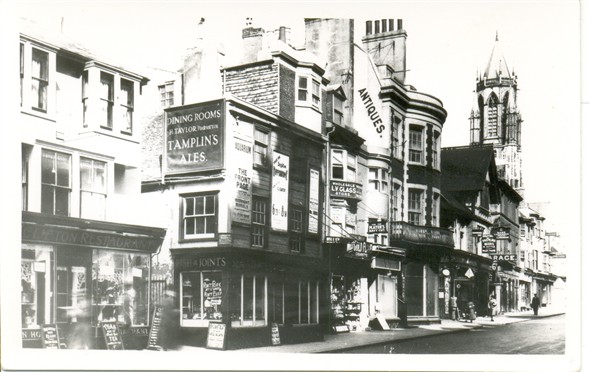 |
| King's Head, No. 9 West Street, Brighton, demolished in 1934 It was formerly the George, and may have been the inn at which Charles waited at Brighton |
Now another complication arose. As Charles told Samuel Pepys in 1680, the merchant Mançel who had negotiated with Captain Tattersall had only been told that his passenger was a gentleman who had escaped from Worcester. But the king “observed that the maister of the vessel looked very much upon me. And as soon as we had supped, calling the Merchant [Mançel] aside, the Maister told him that he had not dealt fairly with him: for though he had given him a very good price for the carrying over that Gentleman, yet he had not been cleare with him, for says he, he is the King, and I very well know him to be soe. Upon which the Merchant denying it, saying that he was mistaken, the Maister answered, I know him very well, for he tooke my ship, together with other fishing Vessels at Bright-Hempson in the yeare 1648 (which was when I commanded the King my Fathers Fleete, and I very kindly let them goe againe). But sayes he to the Maister, be not troubled at it, for I thinck I doe God and my Country good service in preserveing the King, and by the grace of God I will venture my life and all for him, and sett him safely on shoare (if I can) in France.
“Upon which the Merchant came and told me what had past between them; and thereby found my selfe under a necessity of trusting him. But I tooke noe kind of notice of it presently to him. But thinking it convenient nott to let him goe home, least he should be asking advice of his wife or any Boddy elce, we kept him with us in the Inn, and satt up all night drinking beer and takeing Tobacco with him.” Charles didn’t want a repeat of what had happened with Stephen Limbry at Charmouth.
 |
| Drinking and takeing Tobacco |
Gounter also described the incident, which he found very distressing. “Supper ended, the King stood his back against the fyer, leaning over a chaire. Up comes mine host … runs to the King, catcheth his hand; and kissing it, said, ‘It shall not bee said but I have kissed the best man’s hand in England.’
 |
| Brighthelmstone by J.M.W. Turner |
“About a quarter of an hower after, the King went to his chamber, where I followed him, craved his pardon with earnest protestation that I was as innocent, soe altogether ignorant of the cause how this had happened. ‘Peace, peace, Colonell,’ said the King, ‘the fellow knowes mee, and I him. He was one … that belonged to the back-staires to my Father. I hope he is an honest fellow.’”
The king was lucky, and the host and Captain Tattersall were
among the many people over the course of his adventures who recognized him but
didn’t give him away.
Still, things didn’t progress smoothly that night. Gounter asked Tattersall “in what readiness he
was. He answered hee could not off that
night, because, for more securitie, he had brought his vessel into a creeke and
the tyde had forsaken it, soe that it was on the ground… [A]ll the whyle the
business had beene in agitation, to this very tyme, the winde had beene
contrarie. The King then opened the
windowe, tooke notice that the wind was turned, and told the master of the ship,
Whereupon, because of the wind and a cleare night, I offered 10li. More to the man to get of that night. But that could not bee.” |
| Posy ring given to Captain Tattersall by Charles II from The Flight of the King |
“In this contest, the King happily enterposed: ‘Hee saith right (saith his Majestie),’ a gentlemans word, especially before witnesses, is as good as his bond. At last the man’s stomach came downe; and carrie them he would, whatever came of it; and before he would be taken, he would runn his boate under the ater. So it was agreed that about twoe in the night they should bee aboard.
“The boateman in the meanetyme went to provide for necessaries, and I persuaded the King to take some rest. He did, in his cloaths, and My Lord Wilmot with him, till towards twoe of the night.”
Thursday, October 13, 2011
October 13, 1651 - Charles as "Brother Roundhead"
At two o’clock in the morning of October 13, Charles left
Heale House by the back way to meet Colonel Phelipps for the clandestine
journey to Shoreham, where Captain Tattersall was to be waiting with his coal-brig
Surprise, to carry the king to
safety.
 Phelipps was bringing the king’s
horse from where it had been hidden at a neighbor’s house, but according to his
account, he “came to the place at the time appointed, but had the misfortune to
have the King’s horse, at the entring of the meadowe gate, to breake his bridle
and run upp the river – which, after some short time, with noe small trouble,
he recovered and brought back. And
having in some tolerable manner amended what had bin broken, the King and the
Collonel sett forward to Brighthempson.”
Phelipps was bringing the king’s
horse from where it had been hidden at a neighbor’s house, but according to his
account, he “came to the place at the time appointed, but had the misfortune to
have the King’s horse, at the entring of the meadowe gate, to breake his bridle
and run upp the river – which, after some short time, with noe small trouble,
he recovered and brought back. And
having in some tolerable manner amended what had bin broken, the King and the
Collonel sett forward to Brighthempson.”
As the king later told Samuel Pepys, he and Phelipps were to meet Gounter and Wilmot “some 14 or 15 Myles off on my way towards Shoram, and were to lodge that night at a place called Hammelton, 7 Myles from Portsmouth, because it was too long a Journey to goe in one day to Shoram.”
The plan was that Charles would spend the night at the home of Mr. Hyde or possibly with Gounter’s sister, but Wilmot and the Gounters needed a plausible reason to be seen riding around while they waited for Phelipps and the king. So, as Gounter recalled, “the Lord Willmot, Colonel Gounter and Captaine Thomas Gounter, being alltogether att dinner, agreed to ride upon the Downes. The Colonel, for a blinde, went to Hambledon, hard by, to give his sister a visit, and there borrowed a brace of grey-hounds,” telling her “that his Cozin Gounter and other gentlemen were upon the Downes and had a mind to have a course att a haire. And ‘twas possible, if they did not beate to farre and should stay out late, they might all come and bee merry with her that night… ‘If you doe, you shall be heartily welcome,’ was her answer.
“The Colonel brought the greyhounds, and beate with my Lord
and his cozin untill his tyme served, and then left them, resolving to ride untill
he mett the King. And just as he came to
Warneford townes-end from old Winchester, he met Colonel Phillips conducting the
King. Beeing near the houses, the
Colonel ridd by them and tooke noe notice, went to an inne in the towne, called
for some beere and tooke a pipe, and stayed soe long, that they were atop old
Winchester before he overtook them.”
Having “directed them the safest way,” Gounter went to find
Wilmot, and all the men gathered. When
they reached “Brawde-Halfe-Penny, a little above Hambledon, the King spake to
the Colonel: ‘Canst thou get mee a lodging hereabout?’ The Colonel told him that his Cozin Hyde’s
house aforesaid was taken up for him and was very convenient, beeing neere and
in the way. But whether his Majestie
thought it to publick a place, or what other reason I know not, hee said, ‘know
you noe other?’ ‘Yeas, may it please your Majestie, I know divers yeomanly men
where for a night we may be welcome. And
here is one whoe married my sister, whose house stands privatly and out of the
way. ‘Lett us goe thither,’ said the
King.
“Whylest wee were consulting this affaire, Captaine Thomas
Gounter … and Swan, my Lord Wilmot’s man, ridd scouting about Broade-Halfe-penny
… the Colonel conducting the King, my Lord Willmot, and Colonel Robert Philipps
to his sisters house, a private way and the backside of Hambledon, it being but
halfe a mile from the place aforesaid.”
The party arrived at the home of Gounter’s sister at “about candlelighting.” She brought them “wine, ale, and biskets … with a very cheerefull countenance, as though the Kings presence had had some secret influence upon her [and she] suspected nothing lesse then that a king was present.
“In an hower’s space wee went to supper, being all sett promiscuously att a round table: and having halfe-supt, in comes the Colonel’s sister’s husband, Mr. Thomas Symones, whoe, as it plainly appeared, had been in company that day. ‘This is brave,’ said he, ‘a man can noe sooner be out of the way, but his house must be taken up with I know not whome.’”
Symonds welcomed his brother-in-law Gounter, but “peeping in the King’s face, said of him, ‘Heer’s a Round-head’; and addressing his speech to the Colonel, said, ‘I never knew you keepe Round-heads’ company before.’ To which the Colonel replyed, ‘’Tis noe matter; he is my friend and, I will assure you, no dangerous man.” Att which words, he clapt himself downe in a chaire next the King, and tooke him by the hand, shaking him, and saying ‘Brother Roundhead, for his sake thou art wellcome.’ …
“Now and then he would sweare before he was aware, for which
the King reprooved him, ‘O deare brother, that is a ’scape: sweare not, I
beseech you.’ Nevertheles, in that humor
he was, hee plyed us hard with strong waters and beare…
"Supper being ended, it beeing tenn of the clock, the
Colonel began to bethinck himself that the King had ridd neere fourty miles
that day, and was to undergoe a very hard journey the next; and how to get the
King out of his company and to bed, he could hardly devise. Yet the Colonel whispered his kinsman in the
eare, saying … “hee is a Round-head indeede, and if wee could gett him to bed,
the house were our owne, and wee could bee merry.’ Hee readily submitted, and the Colonel
presently (leaving the Lord Wilmot behind) conducted the King and Colonel Rob.
Philips (whoe lay in the Kings chamber) to bed.
 Phelipps was bringing the king’s
horse from where it had been hidden at a neighbor’s house, but according to his
account, he “came to the place at the time appointed, but had the misfortune to
have the King’s horse, at the entring of the meadowe gate, to breake his bridle
and run upp the river – which, after some short time, with noe small trouble,
he recovered and brought back. And
having in some tolerable manner amended what had bin broken, the King and the
Collonel sett forward to Brighthempson.”
Phelipps was bringing the king’s
horse from where it had been hidden at a neighbor’s house, but according to his
account, he “came to the place at the time appointed, but had the misfortune to
have the King’s horse, at the entring of the meadowe gate, to breake his bridle
and run upp the river – which, after some short time, with noe small trouble,
he recovered and brought back. And
having in some tolerable manner amended what had bin broken, the King and the
Collonel sett forward to Brighthempson.”As the king later told Samuel Pepys, he and Phelipps were to meet Gounter and Wilmot “some 14 or 15 Myles off on my way towards Shoram, and were to lodge that night at a place called Hammelton, 7 Myles from Portsmouth, because it was too long a Journey to goe in one day to Shoram.”
The plan was that Charles would spend the night at the home of Mr. Hyde or possibly with Gounter’s sister, but Wilmot and the Gounters needed a plausible reason to be seen riding around while they waited for Phelipps and the king. So, as Gounter recalled, “the Lord Willmot, Colonel Gounter and Captaine Thomas Gounter, being alltogether att dinner, agreed to ride upon the Downes. The Colonel, for a blinde, went to Hambledon, hard by, to give his sister a visit, and there borrowed a brace of grey-hounds,” telling her “that his Cozin Gounter and other gentlemen were upon the Downes and had a mind to have a course att a haire. And ‘twas possible, if they did not beate to farre and should stay out late, they might all come and bee merry with her that night… ‘If you doe, you shall be heartily welcome,’ was her answer.
 |
| Hunting fallow deer with greyhounds |
 |
| Drinking and smoking in a 17th century inn |
 |
| Pension granted to Robert Swan, Lord Wilmot's man, after the Restoration |
The party arrived at the home of Gounter’s sister at “about candlelighting.” She brought them “wine, ale, and biskets … with a very cheerefull countenance, as though the Kings presence had had some secret influence upon her [and she] suspected nothing lesse then that a king was present.
“In an hower’s space wee went to supper, being all sett promiscuously att a round table: and having halfe-supt, in comes the Colonel’s sister’s husband, Mr. Thomas Symones, whoe, as it plainly appeared, had been in company that day. ‘This is brave,’ said he, ‘a man can noe sooner be out of the way, but his house must be taken up with I know not whome.’”
Symonds welcomed his brother-in-law Gounter, but “peeping in the King’s face, said of him, ‘Heer’s a Round-head’; and addressing his speech to the Colonel, said, ‘I never knew you keepe Round-heads’ company before.’ To which the Colonel replyed, ‘’Tis noe matter; he is my friend and, I will assure you, no dangerous man.” Att which words, he clapt himself downe in a chaire next the King, and tooke him by the hand, shaking him, and saying ‘Brother Roundhead, for his sake thou art wellcome.’ …
 |
| Roundheads, with their cropped hair on the right, Royalist Cavaliers, with their long hair, on the left |
 |
| A punch bowl that Charles presented to the Symonds family after his Restoration |
Subscribe to:
Posts (Atom)