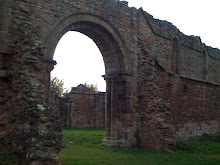
At about 3 a.m. on Saturday, September 6, Charles and Richard Penderel arrived at Boscobel, very close to Whiteladies, from which they had set forth on Thursday evening. The king stayed in the woods near the house while Penderel went in to reconnoiter.
 |
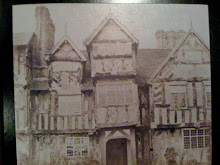
| Boscobel in 1798 |
 |
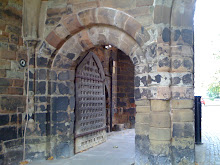
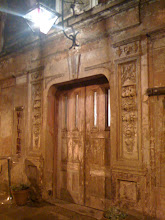
| Entry to priest hole, Boscobel |
It turned out that another refugee from the Battle of Worcester was already there – Colonel William Carliss, who had been in Worcester to the bitter end, having seen the last man killed before he made his escape. Carliss, another local Catholic, had also thought of the priest holes at Boscobel, and had made his way there over three days, hiding in the fields to evade the Parliamentary cavalry patrols scouring the countryside.
 |
| Priest hole, Boscobel |
 |
| Hatch into priest hole at Boscobel House |
 |
| Looking down into priest hole, Boscobel House |
 |
| Boscobel House, turn of 20th century, from The Flight of the King |
Richard Penderel and his brother William brought Charles into the house, and after learning from William that Wilmot was being sheltered at nearby Moseley Hall, Charles summoned Carliss and consulted with him about what they should do, as day was coming on. Carliss told the king “that it would be very dangerous for me either to stay in that House or to goe into the Wood (there being a great Wood hard by Boscobel), that he knew but one way how to pass the day, and that was to get up into a great Oake in a pretty plaine place, where we might see round about us; for the Enemy would certainly Search all the Wood for People that had made their Escape.”
 |
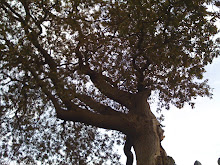
| The successor to the Royal Oak |
 |
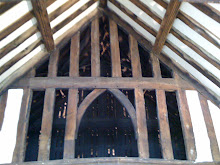
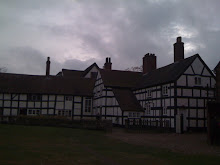
| The rear of Boscobel, October 2009 |
William’s wife gave Charles some bread and cheese and made him a posset of milk and small beer. Just as important, she did what she could to ease the agony of his feet. She heated water while Colonel Carliss helped Charles take off his shoes and stockings, which were sopping wet and full of gravel. There were no shoes in the house that would fit the king, but Mrs. Penderel put hot embers in the wet shoes to dry them, and after bathing his bloody and blistered feet, gave him clean stockings.
 |
| William Penderel at the age of 84 |
Dawn was breaking, so Carliss and the king, carrying some bread, cheese, and small beer, used William Penderel’s ladder to climb “up into a greate Oake that had been Lop’t some 3 or 4 Yeares before, and being growne out again very Bushy and Thick, could nott be seen through.” From their perch, they could see “soldiers goeing up and downe in the thickest of the Wood, searching for persons escaped.”
 |
| The descendant of the Royal Oak, October 2009 |
Charles had now spent three days and nights with very little sleep, and with nothing now to do but hide, he went to sleep on the broad branch of the oak, lying on a couple of pillows that had been handed up into the tree and resting his head on Carliss’s arm. After a while, Carliss’s arm grew so numb that he couldn’t hold onto Charles and keep him from falling out of the tree. He had to wake the king, but was worried that if he spoke, he might be heard by the searching soldiers. So he pinched the king, waking him silently.
 |
Charles and Carliss in the Royal Oak
from Isaac Fuller's series of paintings |
 |
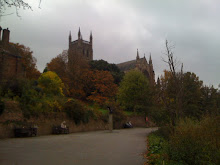
| Boscobel House, October 2009 |
 |
| Boscobel House and outbuildings, October 2009 |
While Charles and Carliss hid in the tree, Richard Penderel went to Wolverhampton to buy wine and biscuits for the king, and another brother, Humphrey, went into Shifnal, using the excuse of paying a levy to find out what the news was. While he was handing over the money, a Parliamentary colonel came in. Cromwell’s soldiers had some reason to think the king had been in the neighborhood, and finding that Humphrey lived near Whiteladies, the colonel began to question him. Thinking fast, Humphrey said that a group of Royalist gentleman had been at Whiteladies on the morning after the battle, but they were no long gone and he didn’t know if the king had been among them.
 |
Post-Restoration broadsheet
about the Penderels's help to Charles |
When it was dark, Charles and Carliss came down out of the tree–which came immediately to be known as the Royal Oak–and ravenously ate the chicken dinner that Mrs. Penderel had prepared. Charles was alarmed to hear Humphrey’s news, especially that a reward of a thousand pounds was offered for his capture. This was an enormous amount of money–enough to support a country family comfortably for years–literally a king’s ransom. But the Penderels assured him that nothing would induce them to give him up. And he had no choice but to trust them.
 |
Boscobel House, October 2009
photo by Alice Northgreaves |
Charles must have felt relieved and relaxed, for he sat in an arbor on the grounds of Boscobel and drank wine.
 |
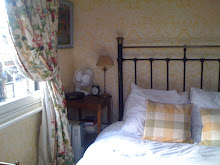
| The bed at Boscobel in which Charles slept |
 |
| Bedroom in which Charles slept at Boscobel |
After supper, Carliss had asked the king what he would like for dinner the next day, Sunday. Charles said he’d fancy some mutton, not realizing that it was a luxury for his simple hosts. There was neither mutton in the house nor sheep belonging to William Penderel, and it would call attention to the household to go to buy it, but here were ways around this problem.
 |
| Chicken in the yard at Boscobel House |
On Sunday morning William Penderel and Carliss picked out one of the best sheep belonging to a neighbor, and Carliss stabbed it with his dagger. They brought it into the cellar and hung it up. When dinner time came, the king himself cut some of the mutton into what he called Scotch collops, and he and Carliss worked together to fry them with butter, giving rise to a jocular dispute as to who was the master cook.
 |
Carliss's arms, including three crowns
and the Royal Oak. After the Restoration,
Charles permitted him to change his name
to Carlos, i.e., Charles |
 |
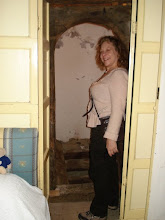
| Alice Northgreaves at Boscobel House, October 2009 |
 |
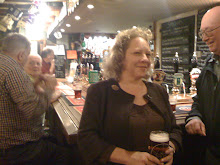
Me, visiting Boscobel in October 2009
photo by Alice Northgreaves
|
 |
| Entrance to priest hole at Moseley Hall |
The Penderels had arranged with Thomas Whitgreave of Moseley Hall, where Wilmot had been staying, that Charles would go there. So late that rainy Sunday night the brothers, armed with clubs and woodsmen’s billhooks, took him there, riding on Humphrey’s mill horse, because by this point his feet were too damaged to walk the eight or ten miles to Moseley.
 |
The Penderels with Charles of Humphrey's mill horse
by Isacc Fuller |
On the way, Charles complained jokingly that the horse was "the heaviest dull jade" he'd ever ridden. Humphrey retorted, "My liege, can you blame the horse to go heavily when he has the weight of three kingdoms on his back?" Charles appreciated the humor, and when the Penderel brothers were summoned to Whitehall to be honored after the Restoration, they reminded the king of the job.
 |
The Penderels accompanying Charles
from a 1660 broadsheet |
It had been decided that Charles should go on foot from Pendeford Mill, with only John and Richard Penderel and their brother-in-law Francis Yates accompanying him to Moseley. When they got there, Charles dismounted and set off, getting a few paces before he realized that he was taking leave of William, Humphrey, and "Trusty Dick" Penderel, who had risked their lives for him. He ran after them and apologized, "My troubles make me forget myself. I thank you all." The brothers kissed his hand and disappeared into the night.
 |
| The Penderels' marks, in lieu of signatures |
At Moseley, Lord Wilmot was waiting anxiously for the king's arrival. He had not told his host, Thomas Whitgreave, who it was that he would be sheltering, but Whitgreaves probably had a good idea already. Whitgreave later recalled that when Charles and his companions finally arrived at the door, the king was so effectively disguised that Whitgreave could not tell which of the men he was, "only I knew all the rest."
 |
| Richard Penderel |

Charles was reunited with Lord Wilmot, who whisked him upstairs to the room of Father John Huddleston, who tutored the boys of the house and acted as chaplain, while Whitgreave took the others into the buttery for something to eat. When Huddleston brought Whitgreaves up to his room, Wilmot announced, "This gentleman is both your master, mine, and the master of us all." Whitegreave and Huddleston knelt and kissed the king's hand, and showed him the priest hole off Huddleston's bedroom.
 |
| The priest hole at Moseley |
I visited Mosely near the end of a day, and had the privilege of walking through the rooms alone after having gone around with a tour. It gave me chills to kneel on the floor and peer down into the very space where Charles hid. It was perhaps four feet square, maybe five, and probably not four feet high, and it can’t have been comfortable, especially for a man who was six feet two, but it would provide safety.
Father Huddleston, seeing that Charles was wearing a very coarse shirt, now filthy from the exertions of the last few days, offered the king his own shirt, as well as clean stockings, and Whitgreave fetched biscuits and sack. Refreshed by food and drink and more comfortable clothes, Charles declared himself ready for another march, and said, “If it shall please God once more to place me in the head of but eight or 12,000 good men, men of one mind, and resolved to fight, I shall not doubt to drive those rogues out of my kingdom.”
 |
| Thomas Whitgreave of Moseley Hall |
Wilmot, thinking Charles safely on his way to Wales, had planned to ride with Jane Lane of nearby Bentley Hall to Bristol, where he could board a ship, but the king's return changed everything. Now it would have to be Charles who rode with Jane, disguised as her manservant – an alarming proposition, given the king’s striking appearance, the Parliamentarians’ frantic efforts to find him, and the terrible temptation of that thousand pound reward.
 |
Proclamation offering £1000 reward
for capture of Charles
|


 Late that night, John Lane rode to Moseley and waited near a stile. Whitgreave met him there and then brought him to the corner of the orchard and went inside to get the king. Charles took leave of old Mrs. Whitgreave, Thomas’s mother, who gave him some almonds and raisins to take with him. He had already been given a catechism which he had admired as being a very pretty book. The night was cold, and Huddleston begged the king to take his cloak, which the king accepted, promising to send it back. Then John Lane, Lord Wilmot, Wilmot’s serving man Robert Swan, and the king set forth for Bentley, about eight miles away, arriving around midnight.