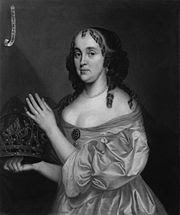
Jane Lane and Charles II

Jane Lane and Charles II

Wednesday, September 28, 2011

September 23, 1651 - more close calls!

On the night of September 22, 1651, Charles sat up late at the inn at Charmouth with Lord Wilmot, Frank Wyndham, Juliana Coningsby, and Wyndham’s servant Henry Peters, waiting for the boat that was to come in on the tide around midnight and carry him to safety. 
As Anne Wyndham recounted, “they remained all night expecting; but seeing no long-boat, neither hearing any message from the master of the ship, at the break of day the colonel returns to the inn, and beseeches the king and the lord Wilmot to haste from thence… The lord Wilmot was desirous to stay behind a little, promising to follow the king to Bridport, whence his majesty intended to make a halt for him.”
But of course once more nothing went right.  Setting out from Charmouth with Wyndham and Juliana Coningsby, one of the travelers Charles passed on the road was a man who had been a servant to his father, and who also knew Wyndham, and obviously recognized both of them.  Fortunately, the man was discreet enough not to greet them and so draw attention to them.
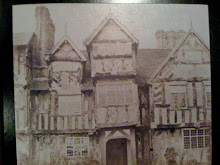
The George Inn at Bridport around turn of 20th century
photo from 1908 edition of Alan Fea's The Flight of the King
Further adventures lay ahead when they got to Bridport.  As Charles told Samuel Pepys many years later, “just as we came into the Towne, I could see the Streets full of Redd-Coates, Cromwells Soldiers (being a Regiment of Coll. Haynes’s … (1500 men going to imbarke to take Jerzey) at which Franck Windham was very much startled, and asked me what I would doe.  I told him that we must goe impudently into the best inn in the Towne and take a Chamber there, as the only thing to be done, because we should otherwise miss my Lord Willmott…. So we Rodd directly into the best Inn of the place and found the Yard very full of Soldiers.  I alighted, and takeing the Horses thought it the best way to goe blundering in among them, and lead them through the middle of the Soldiers into the Stable, Which I did and they were very angry with my for my rudeness.

Inn yard of Queen's Head, Southwark, 1880
the yard of the inn at Bridport was probably similar

“As soon as I came into the Stable I took the Bridles off the Horses, and called the Ostler to me to help me give the Horses some Oates.  And as the Ostler was helping me to feed the Horses, Sure, Sir (Sayes the Ostler) I know your face.  Which was noe very pleasant Questian to me, but I thought the best way was to ask him where he had lived? Whether he had alwayes lived there or noe? He told me, that he was but newly come thether, that he was borne in Exeter and had been Ostler in an Inn there, hard by one Mr. Potter’s a Merchant, in whose House I had laine in the time of War.  Soe I thought it best to give the fellow noe further occacion of thinking where he had seen me, for feare he should guess right at Last. 

“Therefore I told him, Friend, Certainly you have seene me there at Mr. Potters, for I served him a good while, above a yeare.  Oh, sayes he, then I remember you a Boy there, and with that was putt off from thinking any more on it but desired that we might drinck a Pott of Beere together. Which I excused by saying that I must goe waite upon my Maister, and get his dinner ready for him, but told him, that my Maister was goeing to London and would return about three Weekes hence, when he would lye there, and I would not faile to drink a pott with him.”
Another view of the yard of the Queen's Head, Southwark
Judging Bridport too dangerous to stay in now, as soon as the party had eaten, “we rode out of Towne as if we had gone upon the Roade towards London, and when we gott 2 Myle off, my Lord Willmott overtooke us, he having observed while in Towne where we were, and told us that he beleived the Shipp might be ready next night, but that there had been Some mistake between him and the Maister of the Shipp.”
At this point occurred one of the many incidents that led the whole saga of Charles’s escape to become known as the Royal Miracle.  As the king and his companions made their way toward Bridport, a company of soldiers was on their trail.  How and why that came to pass I will save for another post.  But the king and his party were feeling spooked, and decided to leave the main road whenever they had the opportunity, and find their way back to Trent.  So when they came to Lee Lane, a small track branching off the main road near Bradpole, they took it, although none of them knew the area.  They were to learn later that taking this alternate route had saved them from certain capture by the troop of cavalry that had thundered by only a few minutes after they left the Dorchester Road.  This bit of serendipity came to be known as the Miraculous Divergence.

1911 re-enactment of the Miraculous Divergence
West Dorset Pageant, July 20, 21, 22
from A.M. Broadley's The Royal Miracle

Stone placed by A.M. Broadley, 1911
to commemorate the Miraculous Divergence
Having taken an unfamiliar road, Charles and his companions didn’t know where they were when they reached a village out in the country about four miles from Lyme.  Wyndham went in to the inn, the George, to make inquiries, and by good luck it turned out that he knew the innkeeper, and knew him to be a staunch Royalist.  He told the man that he and his brother-in-law, Bullen Reymes, who Wilmot strikingly resembled, had broken their paroles by being more than five miles from home and needed a quiet place to spend the night.  The innkeeper put the party in the top story of the inn and brought them supper himself. 


George Inn, Broadwindsor
drawing by Alan Fea, from The Flight of the King
Now came another scare.  A detachment of the Cromwellian Colonel Haines’s regiment, on its way to the coast to ship for Jersey, arrived at the inn at Broadwindsor.  Now Charles and his companions were trapped.  But as happened so often during his odyssey, a piece of bad luck was balanced with an astonishingly good one, at least for the king.  A woman with the soldiers went into labor.  The local authorities found out about it, and fearing the parish would end up bearing the cost of caring for the mother and child, they arrived at the inn to confront the soldiers, and “there arose a very hot conflict.”  While the poor woman was in labor in the kitchen, “this dispute continued till such time as … they were to march to the seaside.”  So everyone who might have taken notice of the fugitive king was too busy to notice him.  Once more, Charles had dodged a bullet.

Outbuilding at George Inn, Broadwindsor
drawing by Alan Fea from The Flight of the King

Monday, September 26, 2011

September 22, 1651 - off to Charmouth

On September 22 Charles set out for Charmouth, with Juliana Coningsby riding pillion behind him as Jane Lane had done, so that he seemed to be her manservant.  As Anne Wyndham wrote, Colonel Frank Wyndham “was his majesty’s guide, whilst the Lord Wilmot, with [Wyndham’s servant] Peters, kept at a convenient distance, that they might not seem to be all of one company.

“In this manner travelling, they were timely met by Captain Ellesden, and by him conducted to a private house of his brother’s among the hills, near Charmouth.  There his majesty was pleased to discover himself to the captain, and to give him a piece of foreign gold, in which in his solitary hours he made a hole to put a ribbon in.”
Ellesden's Farm
from the 1908 edition of Allan Fea's The Flight of the King
Captain Ellesden accompanied the royal party to the Queen's Arms, the little inn at Charmouth, to wait in the room that Peters had reserved for the supposed runaway bridal party. 
The Queen's Arms as it appaeared in the early 19th century
from The Flight of the King
The plan, as Charles told Samuel Pepys years later, was that Stephen Limbry’s boat was “to come out of the Cobb at Lyme, and come to a Little Crick that was just by this Village,” and that Limbry would send the “Boate a Shoare to take is in at the said Creck and carry us over to France, the winde being then very good in the North.”
Interior of the Queen's Arms
from The Flight of the King
About an hour after Ellesden took leave of the king, according to Anne Wyndham, “came Limbry to the inn, and assured the colonel all things were prepared, and that about midnight his long-boat should wait at the place appointed.  The set hour drawing nigh, the colonel, with Peters, went to the sea-side (leaving his majesty and the Lord Wilmot in a posture to come away upon call.” 
The Queen's Arms
from The Flight of the King

Thursday, September 22, 2011

September 20 and 21, 1651 - a new plan!

After more setbacks, Charles now had a new plan.  His host Frank Wyndham had arranged for a boat to put in at Charmouth on the night of September 22, which would carry the Charles and Wilmot to a waiting ship bound for France. 

Wyndham’s first idea had been that the king’s party should travel to Lyme during the day and then go to Charmouth after dark.  But Captain Ellesden had pointed out that there would be a fair in Lyme that Monday, and though a crowd of people might make one more stranger less obvious, it was likely that the recent proclamation of a reward for the king’s capture would be repeated at the fair.  It would be safer for Charles and Wilmot to go directly to Charmouth and wait at the inn there until the boat came in.
But, as Anne Wyndham wrote, “Necessary it was that his majesty and all his attendants (contrary to the use of travellers) should sit up all the night at the inn at Charmouth; that they ought to have command of the house to go in and out at pleasure, the tide not serving till twelve at night.”

Charles and Wilmot were now old hands at cooking up ingenious schemes.  On Saturday, September 20, “Henry Peters (Colonel Wyndham’s servant) was sent to Charmouth inn, who inviting the hostess to drink a glass of wine, told her that he served a very gallant master, who had long most affectionately loved a lady in Devon; and had the happiness to be well loved by her; and though her equal in birth and fortune, yet so unequal was his fate, that by no means could he obtain her friends’ consent, and therefore it was agreed between them that he should carry her thence and marry her among his own allies; and for this purpose his master had sent him to desire her to keep the best chambers for him, intending to be at her house upon the two and twentieth day of that month in the evening, where he resolved not to lodge, but only to refresh himself and friends, and so travel on either that night or very early next morning.  With this love story (thus contrived and acted), together with a present delivered by Peters from his master, the hostess was so well pleased, that she promised him her house and servants should be at his master’s command.”
Charmouth, a village near Lyme on the Dorset coast, was about 28 miles southwest of Trent.  Charles needed a way to get there without drawing suspicion.  Riding with Jane Lane in the persona of her servant Will Jackson had successfully allowed him to hide in plain sight before, but unfortunately, Jane and her cousin Henry Lascelles were now gone.  Fortunately, Lady Wyndham’s niece Juliana Coningsby was at the Wyndhams’ house, and she was cast in the role of the runaway bride, with Wilmot as her groom, and they would ride with the king when the time came.

St. Andrews Church from the window of Charles's room at Trent Manor
But the day of departure was not yet, so Charles remained in Lady Wyndham’s rooms at Trent Manor.  The beautiful medieval church of St. Andrews stands only a few hundred feet from the manor house, and its steeple is clearly visible from the room where Charles was staying.  As he recounted to Samuel Pepys years later, “One day dureing my stay at Trent I heareing the Bells ring (the church being hard by Frank Wyndham’s house) and seeing a Company gott together in the Church yard, I sent downe the maid of the House (who knew me) to enquire what the matter was. Who returning, came up and told me; that there was a Rogue a Trooper come out of Cromwells Army that was telling the people that he had killed me, and that that was my Buffe-Coate which he had then on.  Upon which most of the Village being Fanaticks, they were ringing the Bells and makeing a Bone-fyer for joy of it.”
A buff coat - Victoria and Albert Museum
Made of suede and worn as protection by soldiers, for hunting, etc.
The Rose and Crown, Trent


The king’s reaction to this horrifying story was, “Alas, poor people.”  The celebration at his supposed death must have been sobering, and increased his sense that he was far from home free. 

Also only a stone’s throw from Trent Manor was – and is –the Rose and Crown, an inn and tavern that was built as lodging for the men building the steeple of the church in the fourteenth century.It would certainly have been a gathering place for the locals and any visitors, including the many Parliamentary soldiers in the area and in nearby Sherborne, and that Saturday night, after the rowdy gathering outside the church, was particularly dangerous.(Heather, the present landlady of the Rose and Crown, told Alice and me that Royalist troopers – ghosts – still gather in the pub at night. They’re friendly, she says, but still, she doesn’t go downstairs when she senses they’re there.)

The back of the Rose and Crown, Trent
Heather, the landlady at the Rose and Crown,
who introduced us to Mrs. Hohler at the manor house

Rose and Crown
the old part, where the ghosts sit


 Dinner at the Rose and Crown
one of the best meals I've had anywhere!


Steps at church in Trent
But not all the neighbors were enemies.  Anne Wyndham related that “Upon the Sunday morning after the king came to Trent, a tailor of the parish informed the colonel that the zealots (which swarmed in that place) discoursed over night that persons of quality were hid in his house; and that they intended to search and seize them; and therefore he desired the colonel (if any such there were) to convey them thence, to avoid surprisal.  The colonel (rewarding the good man for his care and kindness toward himself and family) told him that his kinsman (meaning the Lord Wilmot) was not private, but public in his house (for so his lordship pleased to be), and that he believed he would show himself in the church at the time of prayers. 
St. Andrew's Church, Trent
Chest at St. Andrew's Church, Trent - note date of 1629
“When the honest fellow was gone, the colonel acquaints the king what passed between himself and the tailor, and withal besought his majesty to persuade the Lord Wilmot to accompany him to church, thinking by this means, not only to lessen the jealousy, but also to gain the good opinion of some of the fanaticks, [as Wyndham] … seldom came to that place since faction and rebellion had justled out and kept possession against peace and religion.”

St. Andrew's Church, Trent
“…These reasons, joined with his majesty’s command, prevailed with his lordship; and (though he thought it a bold adventure, yet) it not only allayed the fury, but also took out the very sting of those wasps, insomuch that they, who the last night talked of nothing but searching, began now to say that Cromwell’s late success against the king had made the colonel a convert.”
Side of carved pew, St. Andrew's Church, Trent

Apparently the ruse worked.  No one came to search Trent Manor, and later, “all being now quiet about the home, the colonel’s lady (under pretence of a visit) goes over to Sherborn to hear what news there was abroad of the king. And towards evening, at her return, a troop of horse clapt privately into the town. This silent way of entering their quarters, in so triumphant a time, gave a strong alarm to this careful lady whose thoughts were much troubled concerning her royal guest.  A stop she made to hearken out what brought them thither, and whither they were bound, but not one grain of intelligence could be procured by the most industrious enquiry.  When she came home, she gave his majesty an account of many stories, which like flying clouds were blown about by the breath of the people, striving to cover her trouble with the veil of cheerfulness.  But the king … was earnest to know the cause of her discomposure, and to satisfy his majesty’s importunity, she gave him a full relation of the troop at Sherborn, at which his majesty laughed most heartily, as if he had not been in the least concerned.”

“Yet upon a serious debate of the matter, the colonel and his lady supplicated the king to take a view of his privy chamber into which he was persuaded to enter, but came presently forth again, much pleased that, upon the least approach of danger, he could thither retreat with an assurance of security.
View out of closet with priest hole
Trent Manor
Detail of wood paneling at Trent Manor

“All that night the colonel kept strict watch in his house, and was the more vigilant because he understood from Sherborn that the troop intended not to quarter there, but only to refresh themselves and march. And accordingly (not so much as looking toward Trent) about two of the clock the next morning, they removed toward the sea coast.  This fear being over, the king rested all the time of his stay at Trent, without so much as the apprehension of a disturbance.”

Monday, September 19, 2011

September 18 and 19, 1651 - safe at Trent Manor

On the day after Charles arrived at Trent with Jane Lane and Henry Lascelles, it seemed that he was close to finally escaping from England.  Frank Wyndham expected to be able to find a boat to carry the king away, so Jane and Henry set off for home in Staffordshire after nine eventful days riding with Charles.

A 1660 broadsheet recounting Charles's escape
Wyndham rode to Melbury to seek help from Sir John Strangways, and found Sir John’s son, Colonel Giles Strangways.  Anne Wyndham later wrote, “They walked into the park adjoining the house, where Colonel Wyndham imparted the reason and end of his present visit.  Colonel Strangways’ answer was, that he was infinitely grieved, because he was not able to serve his majesty in procuring a vessel according to expectation; that he knew not any one master of a ship, or so much as one mariner that he could trust, all that were formerly of his acquaintance in Weymouth being for their loyalty banished and gone beyond the sea; and in Pool and Lime he was a mere stranger, having not one confident in either.  A hundred pounds in gold he delivered to Colonel Wyndham, to present to the king, which at his return, by command, was deposited in the hands of the Lord Wilmot for his majesty’s use.”
View of garden from Charles's room at Trent

Wyndham went back to Trent to give Charles the gold and convey the bad news that the Strangways family had not been able to provide a boat, but that Giles Strangways had told him that “one Captain William Ellesden of Lime (formerly well known unto him) with his brother John Ellesden … had conveyed over into France Sir John Berkley (afterward Lord Berkley) in time of danger.” Ellesden was apparently a merchant who had been a captain in the king’s army during the war, rather than being a naval captain.

“To this captain, therefore, his majesty sends the colonel, who … took an opportunity to tell him that the Lord Wilmot had made his escape from Worcester, that he lay privately near to him, and that his lordship had earnestly solicited him to use his utmost endeavors to secure him from the hands of his pursuers.”  According to Charles, Wyndham was “forced to acquaint him that it was I that was to be carryed out.” 
Berries growing in Trent
At any rate, according to Mrs. Wyndham, “the captain very cordially embraced the motion, and went with the colonel to Charmouth (a little place near Lime), where, at an inn, he brought to him a tenant of his, one Stephen Limbry, assuring the colonel that he was a right honest man and a perfect royalist.  With this Limbry, Colonel Wyndham treated under the name of Captain Norris, and agreed with him to transport himself and three or four friends into France.  The conditions of their agreement were: that before the two and twentieth day of that instant September, Limbry should bring his vessel into Charmouth road, and on the two and twentieth, in the night, should receive the colonel and his company into his long-boat from the beach near Charmouth, from thence carry them to his ship, and so land them safe in France.  This the colonel conjured Limbry to perform with all secrecy, because all the passengers were of the royal party… Limbry’s salary was sixty pounds, which the captain engaged to pay at his return from France, upon sight of a certificate under the passengers’ hands of their landing there.”
Wyndham then “came back to his majesty and the Lord Wilmot, to Trent, who at the narration of these passages, expressed no small contentment.”
View of garden from Charles's room at Trent
Charles was spending his time at Trent cooped up in Lady Wyndham’s chamber, cooking food for himself and boring holes into coins to give to people as souvenirs, and no doubt trying to believe that somehow he would actually be able to get out of the country and to safety.

Sunday, September 18, 2011

September 17, 1651 - Charles arrives at Trent


Trent Manor, 2009
Charles, Jane Lane, and Henry Lascelles arrived at Trent on September 17.  Colonel Francis and Anne Wyndham had gone for a walk that morning to keep an eye out for the king. When Charles spotted them he called out, “Frank!  Frank!  How dost thou do!”
Road near Trent Manor
“By which gracious pleasances the colonel perceived,” as his wife wrote later, “that though his majesty’s habit and countenance were much changed, yet his heroic spirit was the same, and his mind immutable.”

Wall and yard at rear of Trent Manor
The Wyndhams welcomed Jane Lane and Henry Lascelles at the front of the house, ostensibly as visiting relatives, while Charles was brought in quietly, probably by taking the horses around back in his persona as Jane’s servant Will Jackson.
Trent Manor, 2009
“The colonel (to avoid the jealous eyes of some neighbors) instantly conveyed the king and Mrs. Lane into the Lady Wyndham’s chamber, where the passions of joy and sorrow did a while combat in them who beheld his sacred person; for what loyal eye could look upon so glorious a prince thus eclipsed, and not pay unto him the homage of tears?  But the consideration of his majesty’s safety, the gracious words of his own mouth confuting the sad reports of his untimely death, together with the hope of his future preservation, soon dried them up.”

During my research trip in the autumn of 2009, Margaret Hohler, the present owner of Trent Manor, graciously welcomed my friend Alice and me not only into her home but into her own bedroom, where Charles spent his time at Trent.  It is a charming and beautiful sun-filled upstairs room with honey-colored wood paneled walls and a window looking out over the garden and the nearby St. Andrews Church, which will figure in the story in the next couple of days.
The room where Charles stayed at Trent Manor
Me in the room with the priest hole
photo by Alice Northgreaves
Hatch over priest hole
Closet with priest hole,
looking out into bedchamber
from The Flight of the King
There is a smaller room off the main bedchabmer, with a closet-sized room in which there is a hatch in the floor leading to the priest hole.  
Looking into the priest hole at Trent Manor

When Charles was at Trent, a staircase obscured
the entrance to the little room with the priest hole

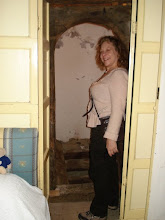
The lovely Mrs. Hohler in the door of
 another bedroom at Trent Manor

There are outbuildings still standing that would have been there in Charles’s time, including a dovecote, a structure containing holes in the wall for doves or pigeons to roost in.


Outbuildings at Trent Manor

The dovecote
Dovecote ceiling
Wilmot and his man Swan also arrived at Trent, and once again there was a conference about how to get Charles out of the country.  Wyndham said that Sir John Strangways "who had given many testimonies of his loyalty, having two sons, both of them colonels" for Charles I, and wholived four miles away at Melbury Court, was likely to have connections to people in the coastal trade or maybe even own some boats that might be used for the king’s escape.  He proposed to ride the next day to consult Sir John.
Interior wall of the dovecote

Barn or stables at Trent Manor
Then Wyndham, who had only recently been paroled from imprisonment in Weymouth for political reasons, “entertained and encouraged his majesty with this remarkable passage of Sir Thomas Wyndham (his father), who, not long before his death (in the year 1636), called unto him his five sons (having not seen them together in some years before) and discoursed … of the loving peace and prosperity the kingdom had enjoyed under its three last glorious monarchs … and notwithstanding the strange mutations and changes in England, he showed how it pleased God, in love to our nation, to preserve an undoubted succession of kings to sit on the regal throne. He mentioned the healing conjunctions of the two houses of York and Lancaster, and the blessed union of the two crowns of England and Scotland, stopping up those fountains of blood which, by national feuds and quarrels kept open, had like to have drowned the whole island.”

Another view of Trent Manor
Old Wyndham went on to tell his sons “We have hitherto seen serene and quiet times, but now prepare yourselves for cloudy and troublesome.  I command you to honour and obey our gracious sovereign, and in all times to adhere to the crown; and though the crown should hang upon a bush, I charge you forsake it not.” 
At Trent Manor, 2009
photo by Alice Northgreaves
Cobbles in yard behind Trent Manor
photo by Alice Northgreaves
Apparently the Wyndham boys hadn’t weren’t familiar with the story of the crown left hanging on a bush when Richard III was killed on the field at Bosworth, and Henry VII plucking it up, for when their father left, they were “in deep consultation what the meaning should be of ‘the crown hanging upon a bush.’”  But the main message was clear, and Frank told Charles, “Certainly these are the days which my father pointed out … and, I doubt not, God hath brought me through so many dangers, that I might show myself both a dutiful son and a loyal subject, in faithfully endeavoring to serve your sacred majesty in this your greatest distress.”

Looking out the window of Charles's room at Trent

It may have been when Charles arrived at Trent that he learned several pieces of bad news. His friend the Earl of Derby, who had suggested Boscobel as a hiding place, had been arrested shortly after parting from Charles as they fled from Worcester, had been charged with treason, and would shortly be tried, which would certainly end in his execution. 

William, Duke of Hamilton
 On September 12, the day Charles had arrived at Abbots Leigh, the Duke of Hamilton had died of the wounds he sustained during the Battle of Worcester.  And on September 16 the Council of State had issued an order for the apprehension of Charles Stuart.

William, Duke of Hamilton