Jane Lane and Charles II

Jane Lane and Charles II

Friday, September 16, 2011

September 15 and 16, 1651 - Castle Cary and Trent

View from grounds of Abbots Leigh
The timing of the events at Abbots Leigh is a little unclear.  It may have been on Monday, September 15 rather than Sunday when Ellen Norton miscarried her baby and an excuse had to be found for Jane to leave.

In any event, the morning after that, Charles set out for Trent, accompanied by Jane Lane and Henry Lascelles.  They planned to spend the night at the home of Edward Kyrton, steward to William Seymour, the Marquess of Hertford.  The Marquess had had been a privy counselor to Charles I and was one of four peers who remained with the king through his trial and acted as pallbearers at his funeral.  He had also commanded troops at several important actions during the war and been governor to young Charles, then Prince of Wales.  In that capacity, he had declined to agree to Parliament's order to ensure that Charles "bee not carried out of the kingdome," and as of 1651 he had been ordered to remain at one of his houses in Wiltshire, and his eldest son Lord Beauchamp was imprisoned in the Tower from April to September 1651.  His steward was likely to provide a safe haven for the fugitive king.

Castle Cary, October 2009
The George, Castle Cary
Kyrton lived at Castle Cary, a village about thirty miles south of Abbots Leigh. When Alice and I were following in Charles and Jane’s footsteps in the autumn of 2009 and trying to discover where Kyrton’s home had been, we followed what had served us so far in looking for locations – we went into the pub in Castle Cary to ask. 

The patrons of the George directed us to Ansford, an adjoining village, saying that the house was covered with bushes or ivy.  We found what we think was the house, called Laydocks.  It is on a hill with sweeping views, and Glastonbury Tor is visible in the distance, prompting me to have Charles comment upon it in my book.


Road in Ansford where Kyrton's house is
The house where Charles stayed at Ansford - I think!

View from house at Ansford
 Glastonbury Tor in the disance somewhere
Sign at Laydocks, the house supposedly belonging to Edward Kyrton
Wilmot had stopped at Castle Cary on his way to Trent to let Kyrton know that three people needing quiet accommodation would be arriving later that day.  Kyrton certain would have known Charles, so it’s likely Wilmot acknowledged that it was the king who would be staying in the house.

On the other hand, Wilmot’s ideas about when to be secretive were a little odd.  As Charles was riding with Jane and Henry Lascelles to Castle Cary, Wilmot was making his way to Trent.  When he got to the home of Francis Wyndham, he sent in Henry Rogers, the man accompanying him who was servant to the sister of Anne Wyndham, Francis’s wife.

Outbuilding at Trent Manor, October 31, 2009
According to Mrs. Wyndham’s account, Rogers told Wyndham “that a gentleman, a friend of his, desired the favour of him that he would please to step forth and speak with him.  The Colonel enquired of Rogers whether he knew the gentleman or his business.  [Rogers] answered no; he understood nothing at all, but only that he was called by the name of Mr. Morton. 

Trent Manor, October 31, 2009
Then, without further discourse, the Colonel came forth, and found the gentleman walking near the stable, whom, as soon as he approached (although it was somewhat dark) he saluted by the title of Lord Wilmot. 

Brick outbuilding at Trent Manor
His Lordship seemed to wonder that he should be known; but it was nothing strange, considering the Colonel’s former acquaintance with him, being one of the first that engaged under his command in his late majesty’s service; besides, his Lordship was not in the least altered, except a hawk on his fist, and a lure by his side, might pass for a disguise.  This confidence of his Lordship really begat admiration in the Colonel, calling to mind the great danger he was in, and whose harbinger he was; for he advertised the Colonel that the King himself was on his way to Trent, intending that very night to lodge at Castle Cary … hoping by God’s assistance to be with him about ten of the clock next morning.”

Old outbuilding at Trent Manor


Yard at rear of Trent Manor
Showing how slowly and inaccurately news traveled, Wyndham had heard that Charles had been killed at Worcester, so “At this joyful news the Colonel was transported … and giving God thanks for his wonderful mercy, he assured his Lordship, That for his Majesties preservation he would value neither his life, his family, nor fortune, and would never injure his Majesties confidence of him; Not doubting, but that God who had led his Majesty through the midst of such inexpressable dangers, would deliver him from all these barbarous threats, and bloody inventions of his enemies.  With these & suchlike expressions, the Colonel brought the Lord Wilmot into his parlour, where he received an exact account of his Majesties condition & present affairs.”

Hall and stairs of Trent Manor today
Wyndham had a large household – twenty-six people, which probably included quite a lot of servants – and the fewer of them who would be around for the king’s arrival the better.  The only people let into the secret were his wife, his mother Lady Wyndham, her visiting niece Juliana Coningsby, two maids named Eleanor Withers and Joan Halsenoth, and a serving man named Henry Peters.  Wyndham made plans to get everyone else out of the way the next morning, planning to lodge the king in his mother’s rooms, “where the servants might wait with most freedom upon his Majesty” and where “a safe place is provided to retreat unto, in case of search, or imminent danger.”  Charles had found another house with a priest hole.

Trent Manor

Wednesday, September 14, 2011

September 14, 1651 - an unexpected tragedy


View downhill from Abbots Leigh
Lord Wilmot, making his way from Packington to Abbots Leigh with his man Robert Swan, had run across an old friend, Captain Thomas Abingdon, who accompanied Wilmot to the home of his friend John Winter at Dyrham, only a few hours’ ride from Wilmot’s destination.  Winters in turn had sent his servant Henry Rogers to guide Wilmot and Swan to Abbots Leigh.  John Pope, the butler at Abbots Leigh, had intercepted them on the night of September 13 and lodged them in the village so Wilmot would not be recognized by members of the household who would be sure to ask questions about Worcester and might put two and two together if they noted the strange dark serving man who had arrived with Jane Lane. 

Road at Abbots Leigh
When Pope learned that there would be no ships for France or Spain leaving from Bristol within a month, Charles once more had to come up with a new plan.  Pope had sneaked Wilmot into the house late on Saturday night, and Charles conferred with them about what to do now.

Pope reminded him that Trent, a village in Dorset not far from the southern coast, was the home of Francis Wyndham, an ardent Royalist and the brother of Sir Edmund Wyndham, who had been governor of Bridgwater during the war, and whose wife Christabella had been nurse to Charles when he was a boy. 

Charles II as a young boy with his siblings
Pope suggested that Francis Wyndham would surely be willing to shelter the king and help him find a boat from one of the southern fishing ports.  And fortuitously, Rogers’s mistress, Mrs. Winter, was the sister of Francis Wyndham’s wife, so he could go along as guide.
Present house at Abbots Leigh, October 2009

Stone wall with ivy, Abbots Leigh
A new plan was now put into action. Wilmot and Swan would ride ahead to Trent to alert the Wyndhams, and the next day, Charles would set out with Jane, Henry Lascelles, and Rogers, spending a night at Castle Cary before arriving in Trent.

Trees at Abbots Leigh
But that afternoon, an unexpected tragedy struck that threw a further complication into Charles’s escape.  The original purpose of Jane Lane’s trip to Abbots Leigh had been to be there when her friend Ellen Norton gave birth to her first baby.  But on the afternoon of Sunday, September 14, Ellen "fell into Labour and miscarry'd of a dead Child, and was very ill." 

17th century anatomical model of
pregnant woman possibly used by midwives
Wellcome Library, London
As Charles recalled, they “could not tell how in the world to finde an excuse for Mrs. Lane to leave her Cousen in that condition,” but “it was not safe to stay longer there, when there was soe greate resort of disaffected Idle people.”  Charles couldn’t leave on his own – Jane was part of his disguise, and it would look very suspicious if her serving man rode off suddenly without her. Moreover, Wilmot had already left, and if Charles did not arrive at Trent as expected, it was likely that Wilmot, Wyndham, and others might put themselves in grave danger riding back to find him. 
Charles, consulting with Lascelles, came up with a scheme worthy of a Restoration comedy: “to counterfeit a Letter [to Jane] … to tell her that her Father was extreamly ill and commanded her to come away immeadiately for feare that she should not otherwise finde him alive.  Which letter Pope delivered soe well while they were all at Supper, and Mrs. Lane playing her part soe dexterously, that all believed Old Mr. Lane to be indeed in great danger, and gave his Daughter the Excuse to goe away with me the very next morning early.”

Jane Lane
from The Flight of the King
Poor Ellen.  Poor Jane.  None of the men who wrote their versions of these events set down how the women felt, but it is a matter of recorded fact that when the party set out in the morning, Jane was not riding behind Charles, but on the other horse, with her cousin Henry.  Too heartbroken and angry to ride with the king is what that looks like to me.

Tuesday, September 13, 2011

September 13, 1651 - danger at Abbots Leigh

Present building at Abbots Leigh
Saturday, September 13 began with a scare, and I don’t think I can improve on Charles’s description of the day’s events.

The buttery was the place where the butts, or barrels,
of beer were kept, and could be used as an informal eating place.
“I rose pretty early, haveing a very good Stomach, and went to the Buttery-Hatch to gett my Breakefast, where I found Pope and 2 or 3 other men in the roome, and we all fell to eateing bread and Butter, to which he gave us a very good Ale and Sack. 

The buttery hatch was where food and drink could be
handed outfrom the buttery.
Buttery Hatch, Clive House, Shrewsbury
And as I was sitting there, there was one that looked like a country fellow satt just by me, who talking gave soe particular an Account of the Battle of Worcester to the rest of the Company, that I concluded he must be one of Cromwell’s soldiers.  But I asking him how he came to give soe good an Account of that Battle, he told me that he was in the King’s Regiment.  By which I thought he meant one Coll. Kings Regiment.  But questioning him further, I perceived that he had been in my Regiment of Guards in Major Broughtons Company, that was my Major in the Battel. I asked him what kinde of a man I was, to which he answered by describeing exactly both my Cloathes and my Horse and then looking upon me he told me that the King was at least 3 fingers taller than I. Upon which I made what hast I could out of the Buttery, for feare he should indeed know me, as being more afraid when I knew he was one of our owne Soldiers then when I took him for one of the Enemys.So Pope and I went into the Hall, and just as we came into it, Mrs. Norton was comeing by through it.  Upon which, I plucking of my Hatt, and Standing with my Hatt in my hand as she past by, I observed, just as I was putting off my Hatt, that Pope looked very earnestly in my Face. But I tooke noe notice of it, but put on my Hatt againe, and went away, walking out of the House into the field.

By "hall" Charles meant the great hall, a common feature of \
medieval and Tudor houses, such as this one at Gainsburgh Hall, Lincoln
I had not been out half an hower, but comeing back I went up to the Chamber where I lay; And just as I came thether, Mr. Lassells came to me, and in a little trouble said What shall we doe? I am affraid Pope knows you, for he says very possitively to me that it is you, but I have denyed it.  Upon which I presently without more adoe asked him whether he was a very honest man or noe; whereto he answering me that he knew him to be soe honest a fellow that he durst trust him with his Life, as having beene always on our Side, I thought it better to trust him then goe away leaveing that Suspicion upon him; and thereupon sent for Pope and told him that I was very glad to meete him there and would trust him with my life as an Old acquaintance. 

"Upon which, being a discreet fellow he asked me what I intended to doe, for sayes he, I am extreamely happy I know you, for otherwise you might run greate danger in this House.  For though my Maister and Mistress are good people, yet there are at this tyme 1 or 2 in it that are very great Rogues, and I thinck I can be usefull to you in any thing you will command me.  Upon which, I told him my designe of getting a ship (if possible) at Bristoll, and to that end bad him goe that very day immeadiately to Bristoll to see if there were any Shipps goeing either to Spain or France that I might get a passage away in.
View from grounds of Abbots Leigh

Brick outbuilding at Abbots Leigh, October 2009

Abbots Leigh, stone wall in garden
Portrait of Charles on snuff box he gave to Jane Lane
I told him also that my Lord Willmot was comeing to meet me here (for he and I had agreed at Coll. Lanes, and were to meete this (very) day at Nortons); upon which, Pope told me that it was most fortunate that he knew me and had heard this from me, for that if my Lord Willmot should have come hither he would have beene most certainly knowne to Severall people in the House; and therefore he would goe and accordingly went out and mett my Lord Willmott a Myle or two off of the House, carrying him to an Ale-House not farr off, where he lodged him till it was night, and then brought him hither by a back Door into my Chamber, I still passing for a Serveing man.”


Trees at Abbots Leigh

Jane Lane

Monday, September 12, 2011

September 12, 1651 - adventures in Bristol

Charles with Jane Lane and Henry Lascelles
17th century Bristol
On Friday, September 12, Charles, Jane Lane, and Henry Lascelles were on the last day of their ride toward Abbots Leigh, but it was also the most dangerous part of their journey.  They would have to pass through Bristol, which was not only a port city likely to be closely watched, heavily populated by soldiers, but also where Charles had spent a lot of time during the war.  Now he was a 21-year-old man rather than the boy of not quite sixteen who had left, but still it was risky.


Part of Millerd's 1673 plan of Bristol
They rode southwest from Cirencester without incident, passing through Tetbury and Chipping Sodbury before they entered Bristol by Lawford’s Gate. 
St. John's Gate, another of the medieval gates of Bristol
 Charles was curious to see what had become of the fortifications made to Bristol by the Royalists after the surrender to Cromwell, and insisted on a detour.   He got lost, and had to ask for directions.  Nevertheless, he and his companions passed through the city unmolested and by late afternoon, reached Abbots Leigh, the home of Jane’s friend Ellen Norton, about three miles outside the city.
The Gatehouse at Abbots Leigh
about 1770
When they rode up to the great home, perched atop a hill, a game of bowls was in progress on the lawn, and several observers were gathered to watch.  They had already determined that it would be best to keep Charles away from the many servants of the household, so Jane told her friend that her man Jackson was getting over an ague and was still weak, and asked that he be given a comfortable room with a fire, or “this boy will never recover.”  Charles thought that “my late Fatigues and want of meate had indeed made me look a little pale.”
Two views of Abbots Leigh in about 1770.  It was torn down in 1814 to make way for a new house.
Mrs. Norton’s solicitousness presented unanticipated dangers. Her butler, John Pope, who directed the maid Margaret Rider to see that Charles got supper and a posset, had not only been a servant to Thomas Jermyn, who had been Groom of the Bedchamber to Charles when he was “a boy at Richmond,” he had also served under Jane Lane’s uncle Colonel Hervey Bagot at Lichfield during the war, so he had certainly seen the king many times.  Moreover, Dr. Gorge, a physician and parson who came to examine Jane’s ostensibly sick servant, had been chaplain to Charles’s father, Charles I.

At least Charles knew that he was among ardent Royalists.  And he was anticipating Lord Wilmot's arrival at the house any time, and expected that Wilmot would quickly be able to find a ship to carry them both to safety in France or Spain.

Broadsheet showing the Battle at Worcester,
Charles with the Penderel brothers, Charles
riding withJane Lane and Henry Lascelles
and the boat to France.

Saturday, September 10, 2011

September 10 and 11, 1651 - Charles Rides with Jane Lane

Charles arrived at Bentley Hall around midnight on Tuesday, September 9.  The Lane family was not Catholic, so there was no priest hole, so he likely spent the night in servants’ quarters, or possibly in the main house.  
Bentley Hall in 1686. Summer house on the left,
banqueting house and stables on the right.
Miniature of Col. John Lane and
pouncet box given to Jane Lane by Charles
The Lanes of Bentley Hall became involved in the king’s escape because Jane Lane, who was probably about 25 years old at the time, had a pass allowing her and a serving man to travel to visit a friend at Abbots Leigh, near Bristol. 

The original plan had been that Charles would make his way to Wales and find a ship from there, and that his friend Lord Wilmot would ride with Jane, pretending to be her servant, and he would set sail from Bristol.  But now it was the king himself who would be riding with Jane, in the persona of Will Jackson, the son of a tenant farmer of the Lanes.

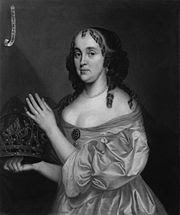
Jane Lane about 1652. 
This portrait hangs at Mosely Old Hall and is used
by gracious permission of the National Trust.
On the face of it, the plan seemed wildly implausible.  Charles was Public Enemy Number One to Cromwell’s government.  He was six feet two inches and dark complexioned – not at all typical looking – there were soldiers looking for him everywhere, and there were notices posted in every village in England describing him – and noting the likelihood that he would be in disguise – and offering a vast reward for turning him in.  Moreover, his travels up to this point, only a few miles at a time, had taken place secretly and at night.  Now he would be riding a hundred miles in broad daylight on publicly traveled roads. 

Stables at Bentley Hall, about 1908
Sometime before dawn on September 10, Charles bathed, shaved, trimmed his hair more neatly, and put on the Sunday-best grey broadcloth suit of clothes that a tenant farmer’s son might own.  He also got a pair of shoes that fit him.
Stables at Bentley, about 1908, from The Flight of the King.
It was here that Charles's and Lord Wilmot's horses were hidden
while Wilmot was at Moseley, which was close to the road.
In the morning, the party was ready to set out.  Jane Lane was to ride with Charles, and her cousin Henry Lascelles, a Royalist soldier, was going along for extra protection.  But a last-minute complication was that Jane’s sister Withy and her husband John Petres decided to ride with Jane for the first part of her journey, making their way home to Buckinghamshire.  And they didn’t know that the servant accompanying Jane was actually the fugitive king.

An old print showing Jane Lane, riding pillion
behind Charles, and Henry Lascelles
Hunting and hawking
Jane’s brother John and Lord Wilmot were to set out shortly after the first party, ostensibly going to visit John’s friend Sir Clement Fisher (and Jane's future husband) at Packington in Warwickshire for some hunting.  That way they could catch up to the king and his companions but stay at a distance, so they could have the royal party within sight for a few hours.  Throughout the king’s travels, Lord Wilmot, though he was a wanted man, disdained to wear a disguise, saying it would “look frightfully.” A hawk on his wrist was as much of a costume as he was willing to put on, which at least in this instance was suitable.

Packingon Old Hall
Jane's home after she married Sir Clement Fisher in 1663.

Packington Old Hall, Meriden, Warwickshire, where Wilmot
 and John Lane went to see Jane's future husband, Sir Clement Fisher.

Jane Lane was to ride pillion behind Charles. This was a common mode of transportation for centuries – the man riding astride the horse and controlling it, his female passenger behind him, seated facing sideways on a pillion, a pad or saddle which was attached to the rear of the saddle and secured under the horse’s tail with a crupper, and her feet on a little shelf called a planchette hanging down to one side.


Steve and Jean Emmit. She is riding pillion. 
As you can see, the lady has to snuggle up to the man. Sexy!
Photo provided by Natalie Wooldridge.
The first test of the king’s disguise came immediately.  He offered his arm to Jane to help her onto the horse, but he gave her the wrong arm.  Her mother asked her brother scornfully what simpleton he had got to accompany Jane that didn’t know how to help a lady mount.

Photos of pillions from In the Saddle,
 provided by Mike Glasson of the Walsall Leather Museum

The sun rose on a clear and beautiful day, and Charles must have felt more hopeful than he had since before the battle.  Jane, Henry, and the king were to spend the first night in Long Marston, at the home of the Lanes’ cousins John and Amy Tomes.  They rode southwest from Bentley, through Darlaston, Pleck and Quinton.  But less than two hours after they had left, Jane’s horse threw a shoe.  This was the equestrian equivalent of a flat tire – it simply wasn’t possible to ride very far without having the horse re-shod.

Fortunately, not far ahead lay the village of Bromsgrove, and a blacksmith.  (During my research trip in 2009 my friend Alice and I were directed to the Black Cross as being the inn to which the smithy was attached). 

Alice in front of the Black Cross, the inn
at Bromsgrove
The old smithy at the Black Cross at Bromsgrove

As Charles was posing as a servant, it was up to him to take the horse to be attended to, which he almost certainly had never done, and here he was to come face to face for the first time with people who might recognize him.  The Penderels had coached him so that he moved more like a countryman than a king, and, as he was apparently a gifted mimic, he could imitate the local accent.  He decided to see how well he could so, and described the incident to Samuel Pepys many years later.

Blacksmith's shop; early 20th century
"As I was holding my Horses Foot, I asked the smyth What Newes? He told me that there was noe newes that he knew of since the good newes of the beateing of the Rogues, the Scots.  I asked him whether there was none of the English taken that joined with the Scots.  He answered that he did not heere that that Rogue Charles Steward was taken.  I told him that if that Rogue were taken he deserved to be hanged more then all the rest for bringing in the Scots.  Upon which he said that I spoake like an honest man, and soe we parted.”

Jane Lane riding pillion behind Charles
from a painting at the Houses of Parliament
The party resumed its journey without event until about a mile before they got to Stratford-Upon-Avon, when an old woman in the fields by the side of the road called out to Charles, “Don’t you see that troop of cavalry ahead, Master?” Did she know who he was?  He didn’t know. The worse problem was that there was a troop of horse stopped about half a mile ahead, “the Horses eateing some grass by the wayside, staying there … while their Muster-Maister was providing their Quarters.  Mrs. Lanes sisters Husband … seeing this Troop of Horse just in our way, sayd, that for his part he would not goe by them, for he had been once or twice beaten by some of the Parliament Soldiers, and he would not Runn the venture again.  I heareing him say soe begg’d Mrs. Lane softly in her Eare, that we might not turne back but goe on, for that the Enemy would certainly send after us to enquire who we were, if they should see us turne.  But all she could say in the world would not doe, but her Brother-in-law turned quite round and went into Stradford another way, the troop of Horse being there just getting on Horse-back.”  The king’s party had no choice this time but to ride among the cavalry blocking the narrow road, but this was the first of many times when Charles passed right under the noses of soldiers who were looking for him but failed to recognize him. 
17th century cavalryman. 
Photo from Xerones's photostream on Flickr.
The home of Jane's cousins John and Amy Tomes
Once over the River Avon, Jane’s sister and brother-in-law branched off toward their home, so that now Charles was accompanied only by Jane Lane and Henry Lascelles. They reached Long Marston, a little southwest of Stratford-Upon-Avon, without further problems, but at the home of Jane’s cousin, Charles had another adventure in everyday living.  As a servant, his place was in the kitchen.  The cook asked him to wind up the jack, a mechanical device used to turn a spit over a fire on which meat was roasted.  He grasped the handle but turned it the wrong way, prompting the cook to snap, “What countryman are you that you know not how to wind up a jack?”  Charles, thinking on his feet, said that he was a poor tenant farmer’s son, and that his family didn’t often eat roast meat, and when they did, they didn’t use a jack.
Fireplace in the Tomes house, Long Marston
Jack in the kitchen at Long Marston
Once more the king had successfully passed as someone far different than he was, and they were a third of the way to Bristol.
Tomes house in about 1908
sketch from The Flight of the King
Chipping Camden
old stone marketplace stall
October 2009
The next day was mercifully less eventful.  Charles, Jane, and Henry Lascelles travelled on, south and west, through Chipping Camden and Stow-on-the-Wold, reaching Cirencester by nightfall.  They stayed at the Crown Inn just off the marketplace, Charles sharing a bedroom with Henry, who of course gave the king the big bed and took the servant’s pallet for himself.
Cirencester in an old print
Fire iron in Crown Inn, Cirencester
with royal coat of arms, probably dating from 17th century
When Alice and I were following in Jane’s and Charles’s footsteps in the autumn of 2009, we had a couple of funny incidents involving the Crown Inn.  We passed through the town on our way to Bristol, stopping only for a short walk around the market area.  I popped in to a pub to use the loo, and we were on our way. 
Cirencester marketplace, October 2009
Over the next day or two, I reread some of the accounts of the trip and noted that the Crown Inn was where our travelers had stayed.  When we went back through Cirencester, we wanted to find the Crown – and discovered that it was the very place I’d ducked into a couple of evenings earlier.  This time we stopped and had a meal and a pint there. 

Interior of Crown Inn, Cirencester
I told the bar man about my book, and following Jane and Charles, and he proudly said, “That’s the window he jumped out of.”  Baffled, I asked why Charles should have jumped out a window.  I forget the exact answer, but I think it had to do with Bonnie Prince Charlie, who probably never stayed there. But a good story, nonetheless.

The Crown, Cirencester
Photo by Alice Northgreaves
Wall of church, Cirencester
Church wall, Cirencester

Church at Cirencester

Wheelbarrow outside church at Cirencester.
Note the stone cobbling of the marketplace.