Charles went to bed on the night of October 13 at the home
of Colonel Gounter’s sister and her husband, Thomas Symonds.
According to Gounter, “the King slept well
all night; and by breake of day, the Colonel putting twoe neats-tongues [ox
tongues] in his pocketts, which he thought they might neede by the way, they
sett out and began their journey.”
Charles was traveling with Gounter and his cousin Thomas
Gounter, and Wilmot and his man Robert Swan.
Colonel Phelipps made for London, to make arrangements for money to be
waiting for the king at Rouen. (I’m not sure how he managed this, but apparently he must have had some financial
contact in London who could make the necessary arrangements clandestinely.)
 |
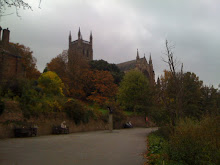
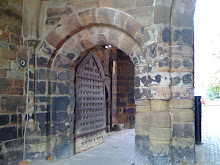
| Arundel Castle |
“They were no sooner come to Arundel hill, as they rode
close by the castle,” but they nearly ran into the Governour, Captaine Morley,
who was out hunting. “The Colonel, the better to avoid them, it being a steepe
hill they were to goe downe, presently alighted, and his company … did as he
did, and soe happily they escaped them.
The King, being told whoe it was, replyed merrily: ‘I did not like his
starched mouchates.’” (I think this means moustache, but haven’t been able to
confirm that! It sounds as if Charles’s
spirits were good, as it seemed that he might actually get out of England soon.)
“So wee came to Howton,” Gounter continued, “where on
horseback wee made a stop at an ale-house for some bread and drinck; and there
our neats-tongues stood us in very good steede, and were heartily eaten.
From thence, being come to Bramber, wee found
the streetes full of soldiers, on both sydes the houses, whoe unluckily, and unknowen
to mee, were come thither the night before to guard.
But luckily (or rather, by a special providence)
were just then come from their guard at Bramber-bridge into the towne for refreshment.
Wee came upon them unawares, and were seene
before wee suspected any thing.”
 |
Bramber Bridge
from Alan Fea's The Flight of the King |
Charles’s heart must have sunk to see the troops – it was a
repeat of the situation he had encountered at Stratford-upon-Avon and Bridport,
though it was good they had left their post guarding the bridge.
“My Lord Wilmot was readie to turne back, when I stept in
and said: ‘If wee doe, wee are undone.
Lett us goe on boldly, and wee shall not be suspected.’
‘He saith well,’ said the King.
I went before, he followed, and soe pass
through without any hinderance.
“It was then betweene three and fower of the clock in the afternoone.
Wee went on, but had not gone farre but a new
terror possessed us: the same soldiers riding after us, as fast as they
could.
Whereupon the King gave mee a
hem.
I slackt my pace till there were
come up to mee, and by that tyme the soldiers were come, whoe rudely passed by
us (beeing in a narrow lane), soe that we could hardly keepe out sadles for
them; but passed by without any further hurt, being some 30 or 40 in number."
Another close call, and just when safety was almost in
sight!
 |
Bagshall's house, Beeding
from The Flight of the King |
“When wee were come to Breeding, a little village where I
had provided a retreatement for the King (one Mr. Bagshall’s house), I was
earnest that his Majestie would stay there a whyle, till I had viewed the
coast.
But my Lord Wilmot would by noe
meanes, for feare of those soldiers, but carried the King out of the
roade.
Soe wee parted: they were they
thought safest, I to Brighthemston, being agreed they should send to mee when
fixed anywhere and readie.”
Eventually Charles, Wilmot, and Swan followed Gounter to
Brighton, where, as Charles recalled “we were to meete with the Maister of the ship,
as thinking it more convenient for us to meet there, then just at Shoram where
the ship was.”
Gounter reached the rendezvous first.
“Being come to the said Brighthemston, I
found all cleere there and the inne (the George) free from all strangers att
that tyme.
Having taken the best roome
in the house and bespoken my supper, as I was entertaining myselfe with a glass
of wine, the King, not finding accommodation elsewhere to his mind, was come to
the inne.
And upp comes myne host (one
Smith by name) ‘More guests,’ saith he to mee.
He brought them up into another roome, I takeing no notice.
It was not long, but drawing towards the Kings
roome, I heard the Kings voice saying aloud to my Lord Wilmot: ‘Here, Mr.
Barlow, I drinck to you.’
‘I knowe that
name,’ said I to myne hoast… ‘I pray enquire, and whether he was not a major in
the Kings army.’”
The host having confirmed that Barlow/Wilmot was the man who
Gounter thought he was, and forestalling any suspicion on the part of the
landlord, Gounter “made a motion to joyne companie and because my chamber was
the largest, that they would make use of it: which was accepted, and soe wee
became one companie againe.
 |
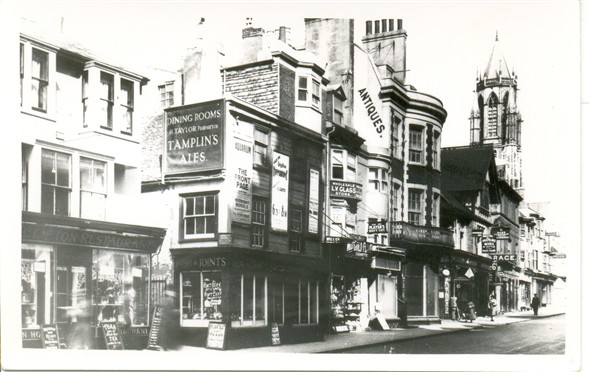
King's Head, No. 9 West Street, Brighton, demolished in 1934
It was formerly the George, and may have been the inn at which Charles waited at Brighton |
“At supper, the King was cheerfull, not shewing he least
signe of feare or apprehension of any daunger, neyther then or att any tyme
during the whole course of this busines.
Which is noe small wonder, considering that the very thought of his ennemies,
soe great and soe many, soe diligent, and soe much interested in his ruine, was
enough, as long as he was within their reach and as it were in the very middest
of them, to have daunted the stoutest courage in the world.”
Now another complication arose.
As Charles told Samuel Pepys in 1680, the
merchant Man
çel who had negotiated with Captain Tattersall had only
been told that his passenger was a gentleman who had escaped from
Worcester.
But the king “observed that
the maister of the vessel looked very much upon me.
And as soon as we had supped, calling the
Merchant [Man
çel] aside, the Maister told him that he had not dealt
fairly with him: for though he had given him a very good price for the carrying
over that Gentleman, yet he had not been cleare with him, for says he, he is
the King, and I very well know him to be soe.
Upon which the Merchant denying it, saying that he was mistaken, the
Maister answered, I know him very well, for he tooke my ship, together with
other fishing Vessels at Bright-Hempson in the yeare 1648 (which was when I
commanded the King my Fathers Fleete, and I very kindly let them goe
againe).
But sayes he to the Maister, be
not troubled at it, for I thinck I doe God and my Country good service in
preserveing the King, and by the grace of God I will venture my life and all
for him, and sett him safely on shoare (if I can) in France.
“Upon which the Merchant came and told me what had past between
them; and thereby found my selfe under a necessity of trusting him. But I tooke
noe kind of notice of it presently to him.
But thinking it convenient nott to let him goe home, least he should be
asking advice of his wife or any Boddy elce, we kept him with us in the Inn,
and satt up all night drinking beer and takeing Tobacco with him.”
Charles didn’t want a repeat of what had
happened with Stephen Limbry at Charmouth.
 |
| Drinking and takeing Tobacco |
But the evening’s alarms were not at an end.
Charles recalled “And heere I also run
another very greate danger… for as I was standing after supper by the
Fire-Side, leaneing my hand upon a Chaire (and all the rest of the Company
being gon into another Roome) the Maister of the Inn came in and fell a-talking
with me, and just as he was looking about and saw there were no boddy in the
roome, he upon a suddain kissed my hand that was upon the back of the Chaire,
and said to me, God bless you, where soe ever you go; I doe not doubt before I
dye but to be a Lord, and my Wife a Lady.
So I laughted and went away into the next Roome, not desireing then any
further discourse with him, there being noe Remedy against my being known by
him, and more discourse might but have raised suspicion.
On which consideracion I thought it best for
to trust him in that manner, and he proved very honest.”
Gounter also described the incident, which he found very
distressing.
“Supper ended, the King
stood his back against the fyer, leaning over a chaire.
Up comes mine host … runs to the King,
catcheth his hand; and kissing it, said, ‘It shall not bee said but I have
kissed the best man’s hand in England.’
 |
| Brighthelmstone by J.M.W. Turner |
“He had waited att the table att supper, where the boatemen
alsoe sate with us, and were then present.
Whether he had seene or heard anything that could give him any occasion
of suspicion, I knowe not.
In very
deede, the King had a hard task, soe to carrie himself in all things that he
might be in nothing like himselfe, majestie beeing so natural unto him, that
even when he said nothing, did nothing, his very looks (if a man observed) were
enough to betray him.
It was admirable
to see how the King (as though he had not beene concerned in these words, which
might have sounded in the eares of another man as the sentence of death) turned
about in silence, without any alteration of counternance or taking notice of
what had beene said.
“About a quarter of an hower after, the King went to his
chamber, where I followed him, craved his pardon with earnest protestation that
I was as innocent, soe altogether ignorant of the cause how this had
happened.
‘Peace, peace, Colonell,’ said
the King, ‘the fellow knowes mee, and I him.
He was one … that belonged to the back-staires to my Father.
I hope he is an honest fellow.’”
The king was lucky, and the host and Captain Tattersall were
among the many people over the course of his adventures who recognized him but
didn’t give him away.
Still, things didn’t progress smoothly that night.
Gounter asked Tattersall “in what readiness he
was.
He answered hee could not off that
night, because, for more securitie, he had brought his vessel into a creeke and
the tyde had forsaken it, soe that it was on the ground… [A]ll the whyle the
business had beene in agitation, to this very tyme, the winde had beene
contrarie.
The King then opened the
windowe, tooke notice that the wind was turned, and told the master of the ship,
Whereupon, because of the wind and a cleare night, I offered 10
li. More to the man to get of that night.
But that could not bee.”
 |
Posy ring given to Captain Tattersall by Charles II
from The Flight of the King |
Gounter also recalled that though Tattersall kept his mouth
shut, he wanted more money, and the carefully laid plan almost fell apart at
the last minute. “When we thought wee had agreed, the boateman starts back, and
saith ‘Noe,’ unlesse I would ensure the barke.
Argue it wee did with him how unreasonable it was, beeing soe well paid
&c., but to noe purpose, soe that I yielded at last and 200
li. was his valuation, which was agreed
upon.
But then, as though he had beene
resolved to frustrate all by unreasonable demands, he required my bond.
At which, mooved with much indignation, I
began to bee as resolute as he, saying, among other thing, there were more
boates to bee had besides his; if hee would not, another should, and made as
though I would go to another.
“In this contest, the King happily enterposed: ‘Hee saith
right (saith his Majestie),’ a gentlemans word, especially before witnesses, is
as good as his bond.
At last the man’s
stomach came downe; and carrie them he would, whatever came of it; and before
he would be taken, he would runn his boate under the ater.
So it was agreed that about twoe in the night
they should bee aboard.
“The boateman in the meanetyme went to provide for
necessaries, and I persuaded the King to take some rest.
He did, in his cloaths, and My Lord Wilmot
with him, till towards twoe of the night.”